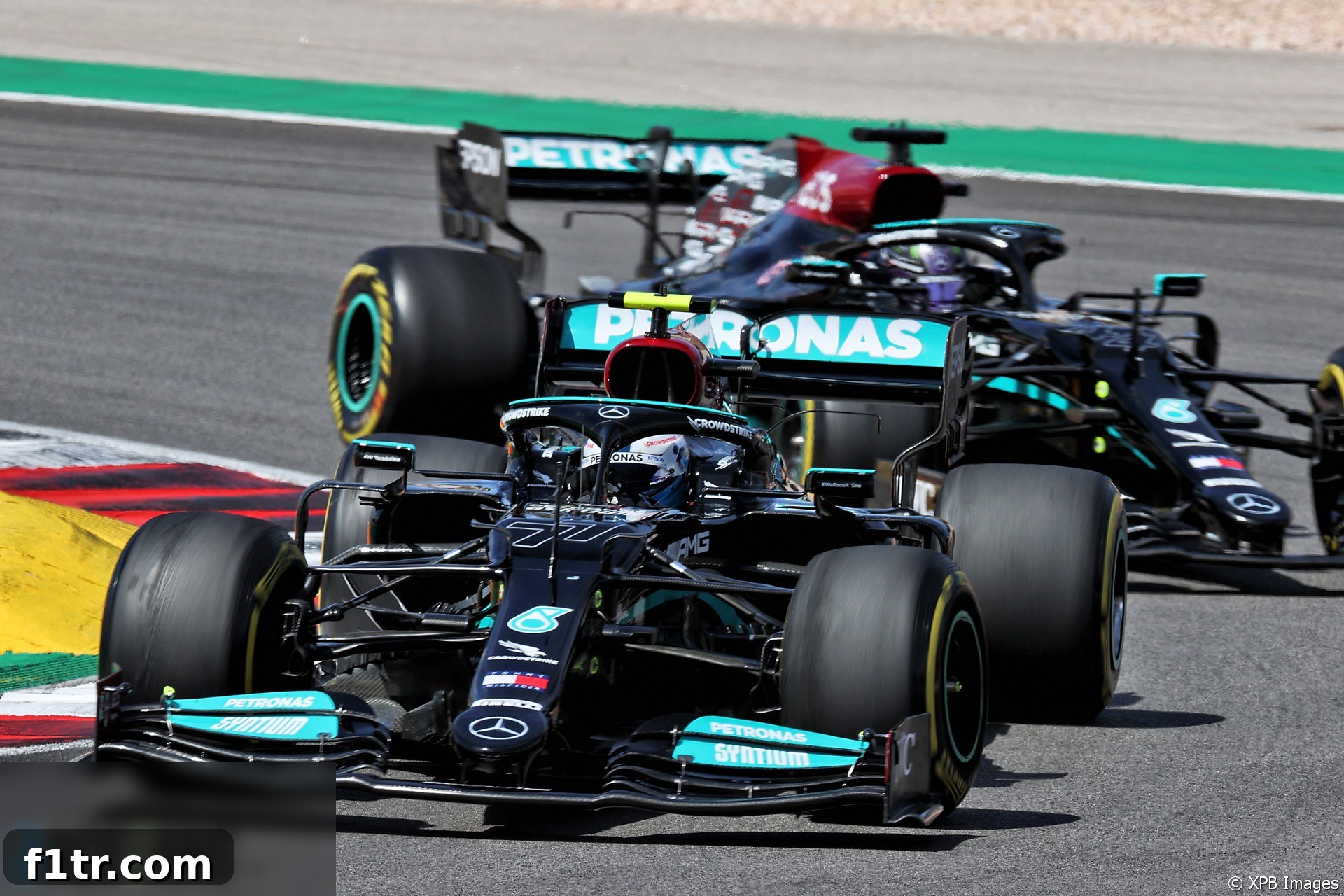
The picturesque Autódromo Internacional do Algarve, better known as Portimão, set the stage for the 2021 Portuguese Grand Prix. For Valtteri Bottas, starting from a commanding pole position, the race was brimming with potential. Yet, what unfolded was a narrative of recurring frustration, as the Mercedes driver once again found himself grappling with enigmatic tire performance, ultimately slipping to a third-place finish. This result, while a podium, was a bitter pill to swallow for a driver who had his sights firmly set on victory.
Bottas’s struggles with tire management weren’t a new phenomenon. Just two weeks prior, at the Emilia-Romagna Grand Prix, his underwhelming pace had been explicitly attributed to difficulties in getting his tires to operate within their optimal window. The pattern repeating itself in Portugal raised significant questions, not just for Bottas, but for the Mercedes-AMG Petronas F1 Team as they navigated a fiercely competitive season against Red Bull Racing.
A Promising Start Derailed by Unexplained Pace Laps
The race began under bright Portuguese skies, and Bottas executed a near-perfect start, confidently holding onto his pole position through the first corners. Following a brief Safety Car period, which was deployed after Kimi Räikkönen’s front wing detached, Bottas maintained his composure and led the field away expertly on the restart. For a fleeting moment, it appeared he had successfully fended off the initial challenges from his teammate Lewis Hamilton and Red Bull’s formidable Max Verstappen.
However, the early optimism quickly began to fade. As the race settled into a rhythm, Bottas found himself unable to match the blistering pace demonstrated by both Hamilton and Verstappen. All three front-runners had started the Grand Prix on the medium compound tires, making the disparity in performance particularly perplexing for the Finnish driver. “When you start from pole position, you have only one target for the race, and that is to win the race. It didn’t happen today, so I’m disappointed,” a visibly dejected Bottas conveyed after the race. He added, with a sense of genuine bewilderment, “I don’t really know in the first stint why I didn’t quite have the pace.”
Bottas elaborated on his initial feelings during the race, stating, “I felt everything in terms of the race start, restart, everything was good from my side. But I could see quite quickly on in the race that with the mediums, I just didn’t have pace like Lewis and Max had. And I have no idea why. I don’t have the explanation.” This candid admission underscored the depth of the challenge he faced – a lack of understanding regarding the fundamental performance of his car’s crucial component: the tires.
The Medium Tire Conundrum: A Lingering Mystery
The medium compound tires were expected to be a strong race tire, offering a good balance of grip and durability. For Hamilton and Verstappen, they delivered as anticipated, allowing them to carve through the lap times with consistent aggression. For Bottas, however, they proved to be a persistent enigma. The subtle nuances of F1 tire management often dictate success, with factors such as driver input, car setup, ambient track temperatures, and even track evolution playing critical roles. For one driver within the same team to struggle so markedly, it points to a complex interplay of these elements.
Speculation often turns to driving style, with some drivers naturally being kinder or harsher on their tires. However, given Bottas’s experience and consistent performance in the past, a complete breakdown in tire understanding points to deeper issues. It could be that his specific car setup, optimised for pole position on Saturday, reacted differently to the full fuel load and race conditions on Sunday. Or perhaps, the track surface, known for its abrasive nature and variable grip levels, simply didn’t suit his approach to extracting performance from the medium tires. Whatever the underlying cause, the lack of pace on a tire compound that worked flawlessly for his closest rivals proved to be a significant impediment to his victory aspirations.
Strategic Pit Stops and the Hard Tire Phase
As the first stint progressed and the performance gap widened, Mercedes eventually brought Bottas in for his mandatory pit stop, swapping his troublesome medium tires for the more durable hard compound. This strategic call was crucial, aiming to extend his stint and potentially find a more comfortable operating window for the car. However, the transition was not without its immediate challenges.
Upon exiting the pits, Bottas found himself immediately under pressure from Verstappen, who had also pitted and was on a charge. The hard tires, by their very nature, require a longer warm-up period to reach their optimal operating temperature and grip levels. This characteristic, coupled with Verstappen’s aggressive out-lap, allowed the Red Bull driver to swiftly overtake Bottas, solidifying his second-place position. “On the first lap [on hards], it was pretty bad. But we knew that the warm-up with the hard tyre was going to be tricky,” Bottas explained, acknowledging the known difficulty but highlighting its immediate impact.
Despite the initial struggle, the hard tires eventually began to deliver the promised performance. Bottas confirmed, “Afterwards, once I got heat in the tyres, it was actually not bad and better than with the medium.” This shift in performance provided a glimmer of hope, suggesting that the car’s balance and his driving style were more harmonious with the harder compound once it was up to temperature. For a period in the second half of the race, Bottas showed improved pace, even managing to close the gap to Verstappen ahead. This recovery demonstrated his inherent speed and the potential of the Mercedes W12 when its tires were working correctly.
The Technical Glitch: A Final Blow to Podium Aspirations
Just as Bottas seemed to be finding his rhythm and mounting a potential challenge for second place, fate intervened with an unforeseen technical issue. “At some point I was catching Max and then I had an issue with one sensor,” Bottas recounted. This sensor malfunction triggered a safety mode within his car’s engine, a protective measure designed to prevent damage to critical components. The immediate consequence was a sudden and significant loss of power.
For an F1 driver operating at the absolute limit, even a momentary loss of power can be catastrophic. In Bottas’s case, it wasn’t momentary; it was substantial enough to cost him precious seconds on track. “Suddenly I lost like five seconds to Max and that was it,” he stated succinctly, outlining the decisive impact of the glitch. This incident not only extinguished any lingering hope of challenging Verstappen for second place but also forced Bottas into a defensive posture for the remainder of the race. Such technical failures, often beyond the driver’s control, are a cruel reminder of the intricate engineering and fine margins that define Formula 1 racing. The five-second deficit created by this sensor issue essentially cemented his third-place finish, adding another layer of disappointment to an already challenging day.
Reflections, Analysis, and the Road Ahead
Coming away from Portimão with a third-place finish from pole position is undoubtedly frustrating for any top-tier F1 driver, especially one in a championship-contending car. For Valtteri Bottas, it was a stark reminder of the fine margins in Formula 1 and the critical importance of understanding every aspect of the car’s performance envelope, particularly the tires.
His post-race comments underscored a determined, yet puzzled, mindset. “But there’s lots of things to look at, to analyse and learn from in the next two days before starting to focus for the next race.” This analytical approach is typical of a professional athlete, intent on dissecting every detail to unearth the root causes of the performance discrepancies. The Mercedes team, with its unparalleled technical resources, would undoubtedly embark on a thorough investigation, examining data from both Bottas’s and Hamilton’s cars to identify why one driver struggled where the other excelled, especially on the medium compound tires.
The consistent nature of Bottas’s tire struggles, evident at both Imola and Portimão, suggests there might be a recurring pattern related to specific tire compounds, track conditions, or perhaps a subtle aspect of car setup that adversely affects his driving style. Resolving this issue is paramount, not just for Bottas’s individual championship aspirations, but also for Mercedes’ fight against a resurgent Red Bull Racing in the Constructors’ Championship. Every point counts in what promises to be an epic battle for supremacy.
Despite the disappointment, securing a podium finish highlights Bottas’s resilience and ability to bring the car home even when faced with significant challenges. The experience at Portimão will serve as a valuable, albeit tough, learning opportunity. The team’s ability to quickly understand and rectify these performance anomalies will be crucial as the season progresses. With the next race often just days away, the turnaround time for analysis and adjustments is incredibly tight, putting immense pressure on both the drivers and their engineering teams.
Ultimately, the 2021 Portuguese Grand Prix for Valtteri Bottas was a race of missed opportunities, marked by an inexplicable lack of pace on the medium tires and compounded by an unfortunate technical glitch. While the podium offered some consolation, the underlying issues demand urgent attention. Bottas, ever the competitor, will undoubtedly channel his frustration into renewed determination, aiming to unlock the full potential of his Mercedes car in the races to come and translate pole positions into hard-fought victories.
2021 Portuguese Grand Prix Insights
- Pirelli’s tyre choice for Portuguese GP wasn’t “too hard”, Hamilton concedes
- Who are the top F1 juniors bidding for a grand prix debut in 2022?
- 2021 Portuguese Grand Prix Star Performers
- Race gains encourage Ricciardo after ‘unacceptable’ qualifying performance
- Sainz says top-five finish was possible after first no-score for Ferrari
Browse all 2021 Portuguese Grand Prix articles