Force India’s Driver Dilemma: Singapore Collision Reignites Team Order Debate in F1
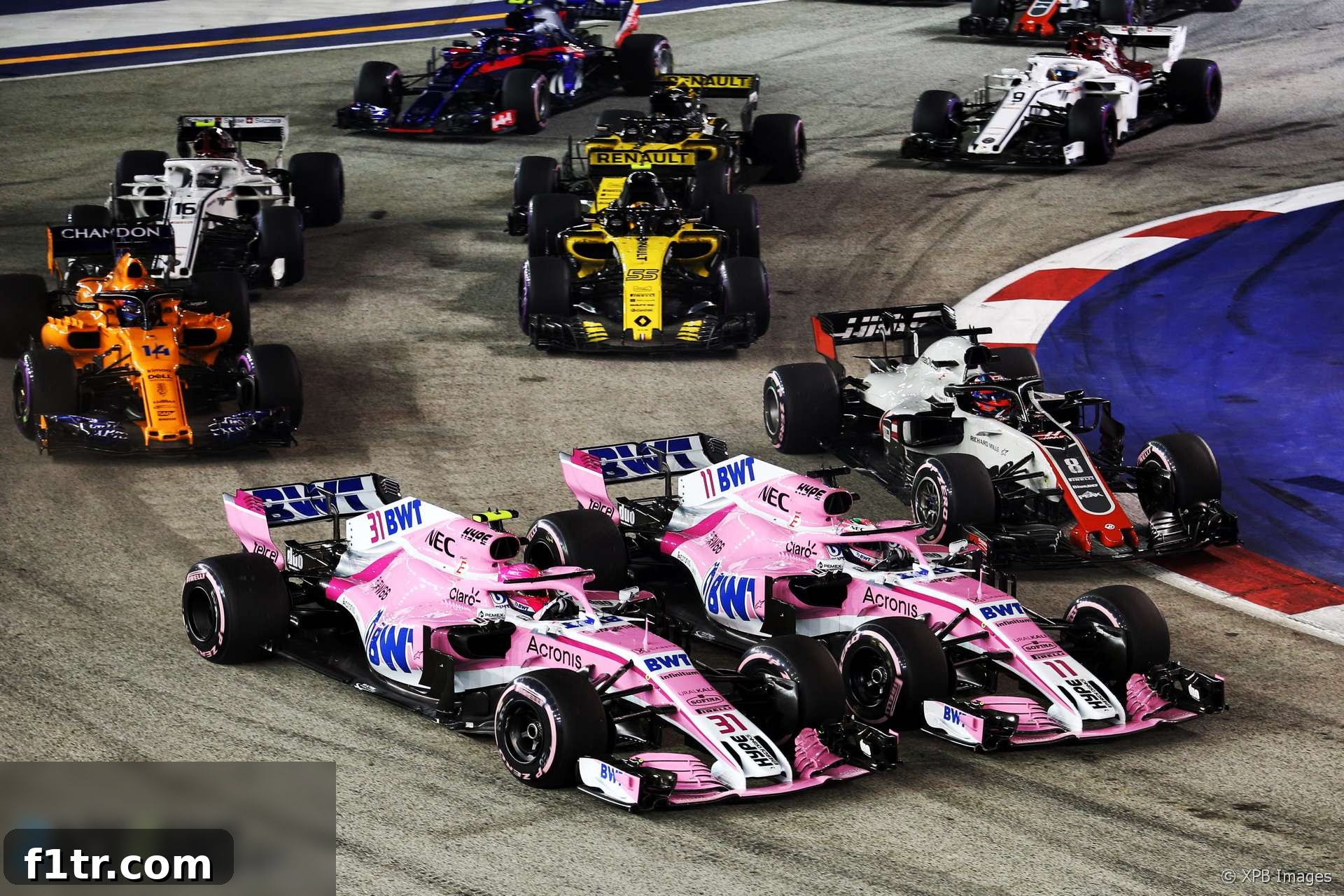
The high-octane world of Formula 1 racing was once again embroiled in internal drama at the Singapore Grand Prix, as Force India teammates Esteban Ocon and Sergio Perez clashed in a costly collision. This incident, occurring on the very first lap, forced Ocon into an early retirement and cast a long shadow over the team’s performance, sharply bringing the contentious debate about team orders back into focus. More than just a racing mishap, it served as a stark reminder of past tensions and signalled a potential return to severe restrictions on driver freedom within the team.
The illuminated and notoriously unforgiving streets of Singapore’s Marina Bay Street Circuit, known for its tight corners and minimal runoff areas, provided the backdrop for the unfortunate event. As the Formula 1 field surged through the challenging opening corners, particularly Turn 3, a critical left-hander, Esteban Ocon’s car made contact with his teammate Sergio Perez. The impact sent Ocon’s car violently into the barrier, resulting in significant damage that immediately ended his race. This premature exit denied Force India crucial points in the Constructors’ Championship, a setback made even more frustrating by its occurrence within moments of the race start, before either driver had the chance to establish their rhythm or optimize their strategy.
Sergio Perez’s Account: A Moment of Unawareness in the Heat of Battle
In the aftermath of the Grand Prix, Sergio Perez offered his perspective on the collision, conveying both regret and an element of surprise regarding the contact. “It was a very unfortunate incident,” he commented, emphasizing the inherent difficulty of avoiding such a clash amidst the close-quarters intensity of an F1 start. “One of those that is very hard to avoid. As I’m picking up the power I just get a clip from one car. I did not even realise that it was Esteban. And then as I get the message from the team I was very sorry for that.” Perez’s explanation highlights the sensory overload experienced by drivers on a street circuit, where blind spots are common, and decisions are made instantaneously. His assertion of not recognizing Ocon’s car underscores the chaotic nature of the opening lap, where multiple vehicles jostle for prime position. While his subsequent apology acknowledged the severe impact on his teammate and the team, it also framed the event as a genuine racing mishap rather than a deliberate act, attributing it to a lack of awareness rather than malice.
Esteban Ocon’s Frustration: A Promising Weekend Derailed
Esteban Ocon, visibly disheartened by his early exit from the race, chose to largely refrain from publicly dissecting the specifics of the collision. Instead, he channeled his frustration towards the broader ramifications for Force India. “I’m not going to comment or analyse what happened,” he stated, a response that perhaps indicated a desire to avoid exacerbating an already tense internal situation. However, his words undeniably conveyed a profound sense of missed opportunity and deep disappointment. “I got a great start and had a good opportunity with good grip to go around Checo [Perez] and the next thing I felt was a hit and I was in the wall.” Ocon’s strong initial launch and the demonstrably competitive pace of the Force India car throughout the weekend made his forced retirement particularly bitter. “What I am going to analyse is that we had great pace the whole weekend. It was supposed to be a great weekend for both of us and right now I’m talking and the race is going on and we are going to come out of this with zero points and that’s terrible.” His comments vividly illustrate the immense pressure on Formula 1 drivers, especially for a talent like Ocon whose future within the sport and with the team was subject to considerable media speculation at the time. The loss of potential championship points not only impacts the team’s financial health and competitive standing but also directly affects individual drivers’ market value in the ruthless F1 paddock.
A Troubled History: The Genesis of Force India’s Team Order Dilemma
This incident in Singapore was far from an isolated event; it represented the latest, and arguably most impactful, chapter in an often-tumultuous rivalry between Esteban Ocon and Sergio Perez. The duo had a series of high-profile and costly clashes during the 2017 Formula 1 season, with notable incidents occurring at the Azerbaijan Grand Prix in Baku and the Belgian Grand Prix at Spa-Francorchamps. These earlier collisions, which resulted in significant damage to both cars and a substantial loss of championship points, ultimately compelled the Force India team management to implement stringent “no racing” orders. These measures effectively forbade their drivers from directly competing against each other on track, especially during critical phases of a race. This policy was deemed an unfortunate but necessary step to safeguard the team’s constructors’ championship aspirations and minimize costly repairs to damaged cars, a perennial and acute concern for a midfield team operating with a more constrained budget compared to the sport’s giants.
However, entering the 2018 season and for a significant period following the 2017 restrictions, the team had made the strategic decision to relax these rigid rules. The prevailing belief was that both drivers had gained maturity, learned valuable lessons from their past mistakes, and could now be trusted to race hard but fairly. This newfound freedom was particularly relevant for the opening lap, where positions are most fluid and gains can be significant. Team principal Otmar Szafnauer elaborated on this policy shift, noting, “It’s been over a year since it [last] happened. It was at Baku last year that we instilled the rules it was at Spa. From Spa until here it hasn’t happened.” This extended period of relative calm and incident-free racing had seemingly validated the team’s decision to grant their drivers more autonomy, allowing them to engage in direct, wheel-to-wheel competition, especially during the fiercely contested initial stages of a Grand Prix. The collision in Singapore, however, brutally shattered this fragile understanding, compelling the team to immediately re-evaluate its entire driver management strategy.
Otmar Szafnauer’s Stern Warning: The Imminent Return of Restrictions
The immediate fallout from the Singapore collision saw Force India’s team principal, Otmar Szafnauer, issue a clear, unequivocal, and stern warning about the potential reinstatement of strict team orders. His statements powerfully conveyed the team’s profound frustration and underscored the extreme gravity of the situation. “So we’re back to the old rules. We allowed them to race on lap one whereas in the past we didn’t allow them to race on lap one and now we can remove that.” This declaration signified a direct and impactful policy reversal, signaling a return to the cautious, restrictive approach that had been deemed essential in the 2017 season. The implications were unambiguous: driver freedom would be severely curtailed if such self-destructive incidents were to recur. For a sport that thrives on exhilarating wheel-to-wheel action and celebrates individual bravery, such restrictions represent a difficult but sometimes unavoidable compromise for a team’s very survival and ultimate success.
Moreover, Szafnauer hinted at even more drastic measures should the clashes persist, delivering a thinly veiled threat to his drivers. “And if they continue to do this, even on lap one there’s other ways to separate them which we hope that we don’t ever have to employ.” This ominous warning could encompass a wide spectrum of interventions, ranging from extreme strategic dictates during a race, such as mandatory staggered pit stops or artificially enforced spacing between cars, to potentially even evaluating the long-term future of one or both drivers within the team. For a team like Force India, which was simultaneously navigating significant financial turbulence and an imminent change of ownership during this critical period, avoiding self-inflicted damage and maximizing every single championship point was not merely desirable, but absolutely paramount. Every point lost due to internal conflict represented a tangible and painful blow to their competitive standing, their financial stability, and their efforts to secure a robust future.
The Broader Debate: Team Orders in Formula 1 – Sport vs. Strategy
The Force India dilemma in Singapore resonated deeply with a broader, long-standing, and often heated debate within Formula 1: the fundamental role and ethical implications of team orders. While passionate fans invariably champion pure, unbridled racing and unfettered competition, team principals and strategists are perpetually tasked with balancing individual driver ambition against the overarching collective goals of the team. Historically, team orders have frequently been a contentious issue, sometimes leading to accusations of unfair play, manipulation of race outcomes, and diminishing the spectacle of motorsport. Iconic examples, such as Ferrari’s infamous “Fernando is faster than you” radio message, vividly illustrate the inherent tension between celebrating individual talent and enforcing a broader team mandate. Teams staunchly argue that maximizing constructors’ points, strategically managing tire wear, or protecting a leading car from a competitor are all legitimate strategic considerations that, at times, necessitate direct intervention from the pit wall.
This incident at the Singapore Grand Prix serves as a stark and timely reminder of the incredibly fine line teams must walk. Allowing drivers the freedom to race unreservedly undoubtedly enhances the sporting spectacle and excites fans, but it also carries inherent and significant risks, especially when highly competitive teammates are involved. Conversely, imposing strict team orders can effectively safeguard precious championship points and conserve vital resources, but it carries the distinct risk of stifling natural talent, dampening the racing spirit, and potentially alienating a fanbase that yearns for genuine, unadulterated competition. Force India’s precarious situation highlighted the particular vulnerability of midfield teams, where every single point is fiercely hard-won and every incident carries a far heavier financial and competitive cost than for the sport’s top-tier outfits, which typically boast much deeper financial reserves and greater resilience to setbacks.
Looking Ahead: Consequences and Path to Resolution
The collision in Singapore had immediate, tangible repercussions and undeniably set the stage for difficult, critical decisions for Force India. For Esteban Ocon, already navigating a period of intense uncertainty regarding his 2019 Formula 1 seat, the incident added yet another layer of complexity and vulnerability to his position. His profound frustration at missed points was compounded by the very real prospect of renewed team restrictions that could severely limit his opportunities to showcase his immense talent to potential future employers. For Sergio Perez, despite being able to continue the race, the incident inevitably placed him under increased scrutiny, particularly given his well-documented past involvement in similar clashes with Ocon. The team’s overall reputation, too, was significantly on the line; a pattern of repeated driver conflicts can project an undesirable image of internal instability and discord, potentially affecting crucial sponsor relations, investor confidence, and the team’s appeal in the highly competitive driver market.
Moving forward, Force India faced the arduous challenge of not only restoring internal harmony but also ensuring their drivers could consistently contribute positively to the team’s overarching objectives without compromising each other. The re-imposition of strict team orders, particularly for the critical opening lap, represented a pragmatic, albeit perhaps unexciting, solution designed to prevent further instances of self-sabotage. Ultimately, the onus would be squarely on both drivers to demonstrate a significantly higher level of situational awareness, professional maturity, and genuine teamwork. Failure to do so would risk facing even more severe consequences that could fundamentally alter the trajectory of their respective careers in Formula 1. The Singapore clash served as an undeniable and emphatic signal that the team’s patience had worn thin, and that collaborative success and the pursuit of collective goals would now take absolute precedence over individual racing ambition.
Related Formula 1 Articles
- F1 Team Management Strategies in High-Pressure Environments
- Legendary Driver Rivalries in Formula 1 History
- The Crucial Impact of Midfield Battles on the Constructors’ Championship
- Navigating the Unique Challenges of F1 Street Circuits
- Financial Implications of Damage and Crashes in Formula 1
Browse all F1 News & Analysis