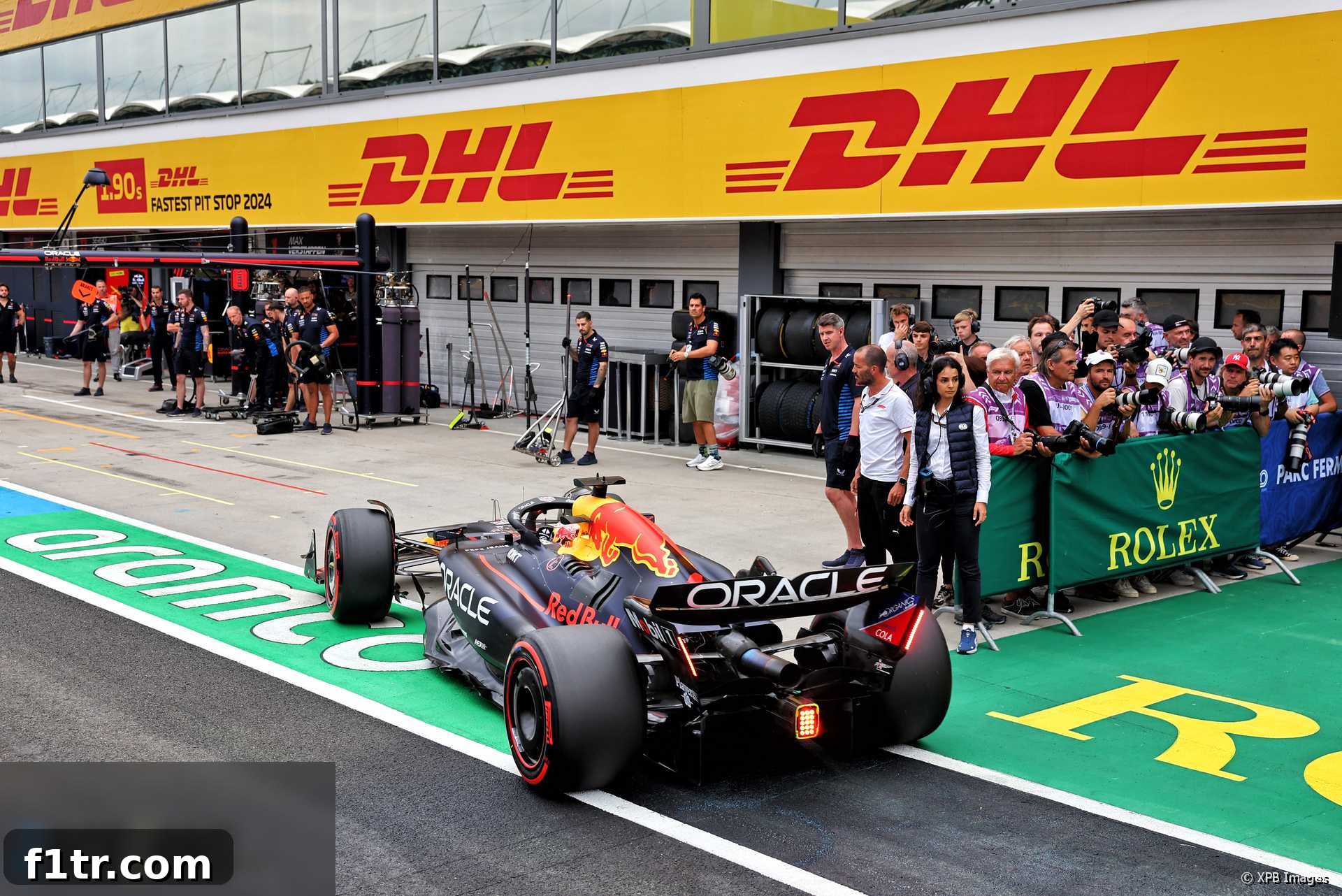
In the high-stakes world of Formula 1 qualifying, strategic decisions can be as crucial as raw pace. Red Bull Racing, a team synonymous with bold moves and championship success, found themselves in a unique predicament during a recent Q3 session. Team Principal Christian Horner revealed the team’s calculated choice not to send reigning world champion Max Verstappen back out on track during the closing moments of qualifying, despite a red flag interruption offering a potential restart. This decision, aimed at mitigating the risk of entanglement in a rival incident, sparked considerable discussion and underscored the intricate balance between aggression and prudence in modern F1.
The dramatic turn of events unfolded in the final segment of qualifying, Q3, where drivers push their cars to the absolute limit to secure the best grid positions. Verstappen had already completed his critical final flying lap on a fresh set of soft tyres, establishing a competitive, though not ultimately pole-winning, time. The session was then brought to an abrupt halt by a red flag, triggered by a crash involving AlphaTauri’s Yuki Tsunoda. With just over two minutes remaining on the clock, there was sufficient time for race control to restart the session, offering a tantalizing last chance for drivers to improve their positions.
Advert | Become a Supporter & go ad-free
Red Bull’s Strategic Retreat: A Calculated Risk Assessment
While several competitors, notably both McLaren drivers, Lando Norris and Oscar Piastri, opted to return to the track for another attempt, Red Bull’s garage remained notably calm. Max Verstappen’s car stayed firmly within its bay, a stark contrast to the flurry of activity seen elsewhere in the pit lane. Horner’s explanation for this unconventional decision centered on a meticulous evaluation of risks versus potential rewards.
One primary concern was the potential for “gamesmanship” from rival teams. With the limited time available, the pit lane exit often becomes a bottleneck, a place where drivers might strategically slow down to gain a tow or impede competitors. Red Bull’s garage, often situated farthest from the pit lane exit at many circuits, exacerbated this risk. This geographical disadvantage meant that getting Verstappen’s car out swiftly and cleanly without being caught in traffic or delayed by rival maneuvers was a significant challenge. Any delay could lead to a less-than-ideal out-lap, compromising tire temperature and ultimately the flying lap itself.
Furthermore, Red Bull had a recent history to consider. Max Verstappen had previously been investigated, and at times penalized, for impeding other drivers during slow out-laps in qualifying, such as an incident in Austria. This past scrutiny likely factored into the team’s cautious approach, as they sought to avoid any further controversies or potential grid penalties that could jeopardize his starting position. Horner candidly stated, “There was only ever going to be some gamesmanship at the end there. We’d done our lap, we had no tyres left. You’re not going to improve on a used set of tyres so better to save the car, keep it in the garage.”
The Tire Factor: A Limiting Constraint
A crucial element in Red Bull’s decision-making process was Max Verstappen’s tire situation. He had already utilized his final set of new soft tires for his best qualifying effort. F1 regulations strictly govern tire allocation, and once a driver has used their allotted new sets, any subsequent runs must be performed on used tires. The performance drop-off from new to used soft tires, particularly in the critical Q3 phase where every thousandth of a second counts, is substantial. Red Bull engineers likely assessed that the marginal gains, if any, from a run on used rubber would be negligible, and certainly not enough to challenge for pole position against rivals on fresh tires or with a strong initial lap.
Beyond the lack of performance improvement, sending the car out again carried additional risks. An unnecessary additional run puts more wear and tear on engine components, gearbox, and brakes – vital elements that must endure the rigors of a full race distance. Moreover, any minor incident, even a small off-track excursion or contact, could result in damage to the car, necessitating repairs that would compromise the meticulous setup for the race. For a team aiming for a flawless Grand Prix weekend, preserving the car and minimizing unnecessary risks is often the wisest course of action.
Competitors’ Fortunes: McLaren’s Attempt and Ricciardo’s Gain
In contrast to Red Bull’s conservatism, both McLaren drivers, Lando Norris and Oscar Piastri, did venture back onto the track. Despite their efforts, neither was able to improve upon their earlier times, highlighting the difficulty of extracting performance in such hurried, high-pressure conditions. Their attempts, however, showcased a different strategic philosophy, perhaps a willingness to gamble for even a small gain, especially given their impressive performance throughout the weekend. McLaren’s P1 and P2 lockout of the front row underscored their strong form and the effectiveness of their car package at this particular circuit.
An interesting outlier in the red flag restart scenario was Daniel Ricciardo. The experienced Australian driver managed to make a rare improvement, moving up to ninth place ahead of Yuki Tsunoda. Ricciardo’s ability to find extra pace under pressure, amidst the chaos of a last-minute scramble, demonstrated that improvements were possible, albeit challenging, for those who took the risk.
Verstappen’s Perspective: Pushing Limits, Acknowledging Gaps
Despite the strategic decision to remain in the garage, Max Verstappen still secured a respectable third position on the grid. He qualified within five hundredths of a second of both McLaren drivers, a testament to his raw speed and the finely tuned Red Bull machinery. Even though he was the only Red Bull driver running their full upgrade package that weekend, Verstappen was candid about the team’s overall performance. “The whole weekend I think we have been a little bit behind and I think that was also the case in qualifying,” he admitted.
Verstappen’s comments highlighted a feeling of chasing rather than dictating the pace. He openly discussed the challenges faced, particularly a perceived lack of grip. In Formula 1, grip is paramount, directly influencing a car’s cornering speed, stability, and driver confidence. A deficiency in this area can significantly impact lap times, especially on circuits demanding high aerodynamic efficiency and mechanical grip. “I tried to make it as close as possible but unfortunately just not enough,” he reflected, emphasizing his maximum effort despite the car’s inherent limitations.
Advert | Become a RaceFans supporter andgo ad-free
Hope for Race Day: A Different Dynamic
Looking ahead to the Grand Prix, Verstappen maintained a degree of optimism, acknowledging that race conditions often present a different dynamic than qualifying. Factors such as tire degradation over longer stints, fuel loads, and the strategic interplay of pit stops can dramatically alter the competitive landscape. “It’s a bit difficult to pinpoint why that is. I would have liked a bit more grip, but it’s not there at the moment. But P3, still very close. I just hope that for tomorrow the car is good in the race and at least we can follow them and see what we can do there.” This sentiment underscores the belief within Red Bull that their car often comes alive on Sunday, demonstrating superior race pace and tire management compared to its single-lap qualifying performance.
The Evolving Competitive Landscape: A “Tricky Situation”
Max Verstappen did not shy away from describing the current situation for Red Bull as “tricky.” The era of seemingly unchallenged dominance appears to be waning, with rival teams, most notably McLaren in this instance, stepping up their game significantly. This increased competition is something Verstappen both relishes and acknowledges as a challenge. “I love competition, but I would like to be on top of the competition and at the moment I feel like we are chasing and having a few more difficult weekends,” he stated. This shift from being the hunted to the hunter signals a new phase in the championship battle.
The intensifying pressure from competitors forces Red Bull to continually innovate and extract every ounce of performance from their package. These “more difficult weekends” serve as crucial learning opportunities, highlighting areas where the car needs improvement and where strategic decisions must be honed to perfection. Verstappen’s concluding remark, “But I don’t back out of a fight,” encapsulates his relentless competitive spirit. It’s a clear declaration that despite the challenges, he and the team are prepared to push harder than ever to reclaim their dominant position and defend their titles against an increasingly formidable grid.
The strategic call in qualifying and Max Verstappen’s honest assessment paint a vivid picture of Formula 1’s evolving competitive landscape. While Red Bull demonstrated caution in a high-risk situation, the underlying message is clear: they are facing a tougher fight than before. The upcoming races will undoubtedly test their resilience, their car development, and Verstappen’s unwavering determination to remain at the pinnacle of motorsport.
2024 Hungarian Grand Prix Coverage and Analysis
- Verstappen names Hungarian GP the most stressful moment of his title-winning year
- McLaren team orders “a new situation we’re inexperienced at handling” – Piastri
- Verstappen dismisses critics of “vocal” radio messages and late-night simracing
- Norris’ former McLaren team mates say he was right to give up win
- Mercedes surprised Hamilton’s car was “completely unscathed” in Verstappen clash
Browse all 2024 Hungarian Grand Prix articles