2019 Austrian Grand Prix: Verstappen’s Comeback Masterclass and Sainz’s Heroic Charge
The 2019 Austrian Grand Prix at the Red Bull Ring proved to be a truly unforgettable event, delivering a spectacle of high-stakes racing, remarkable comebacks, and strategic masterstrokes. While the headlines rightfully celebrated Max Verstappen’s stunning victory, his superb pace in the second half of the race was not the only story of a driver carving their way through the field. This race was a testament to tenacity, strategic brilliance, and the sheer thrill of Formula 1.
Advert | Become a Supporter & go ad-free
Among the standout performances, Carlos Sainz Jnr delivered a drive for the ages. Starting from the very back row of the grid, a consequence of a power unit change penalty, Sainz embarked on an incredible climb through the competitive Formula 1 field. After his crucial pit stop, the McLaren driver unleashed impressive pace, systematically picking off rivals to cross the finish line in a superb eighth position. This monumental effort was all the more impressive considering he sustained damage to his front wing with approximately 10 laps remaining, which undoubtedly hampered his ultimate potential. Despite this setback, Sainz finished an astonishing 11 places higher than where he started, marking the biggest position gain from start to finish by any driver in the 2019 season up to that point. His tenacity and skill were a beacon of McLaren’s resurgence, showcasing the team’s improving performance.
Verstappen’s Resilient Recovery and Strategic Triumph
The race leader, Max Verstappen, faced an immediate challenge from the moment the lights went out. A disastrous start saw his Red Bull RB15 go into anti-stall mode, causing him to lose six valuable positions as he crawled off the grid. The home crowd held its breath as their hero plummeted down the order from his front-row start. He managed to recover one of those places by the end of the first lap, shrewdly passing his teammate Pierre Gasly. At that point, a victory seemed an almost impossible dream, with Charles Leclerc pulling away at the front and the Mercedes cars looking strong.
However, the tide began to turn when Mercedes opted for an early pit stop, a move swiftly mimicked by Ferrari to cover their rivals. This pivotal moment presented Verstappen and Red Bull Racing with a golden opportunity. Opting for a longer first stint, Verstappen pitted nine laps later than the original race leader Leclerc. This extended first stint on the more durable C3 (medium) compound, followed by a switch to the C2 (hard) tyres, allowed him to unlock a significant performance advantage. With fresher rubber and the Red Bull-Honda package finding its stride, Verstappen unleashed blistering pace, rapidly scything through the field. His aggressive yet precise overtakes, particularly in the closing stages against Leclerc, cemented one of the most thrilling and memorable victories of his career, delighting the orange-clad legions in the stands and marking a crucial home win for Red Bull.
Mid-field Misfortunes and Challenging Days
While some drivers surged forward, others faced a race to forget. For Robert Kubica of Williams, his return to Formula 1 continued to be an uphill battle. The Austrian Grand Prix represented one of his most challenging races since his comeback, with his quickest lap time a full second slower than that of his teammate, George Russell. He was ultimately lapped three times by the leaders, underscoring the severe performance deficit of the Williams FW42 chassis and the team’s ongoing struggles at the back of the grid.
Haas also endured another disappointing Sunday after a promising qualifying session. Kevin Magnussen, who had impressively set the fifth-fastest time in qualifying, saw his race unravel dramatically. A drive-through penalty for being out of position at the start further compounded his woes, and he ultimately finished behind George Russell in the struggling Williams, a testament to the difficult race pace issues that plagued Haas throughout the 2019 season. The team’s inability to translate qualifying speed into race performance remained a perplexing and frustrating problem, with both Magnussen and Romain Grosjean struggling for consistent pace and battling tyre degradation.
Advert | Become a RaceFans supporter andgo ad-free
Race Statistics and In-Depth Analysis
The 2019 Austrian Grand Prix provided a wealth of data for fans and strategists alike, revealing the nuances of performance, strategy, and racecraft that defined the event. Below are some of the key statistical insights:
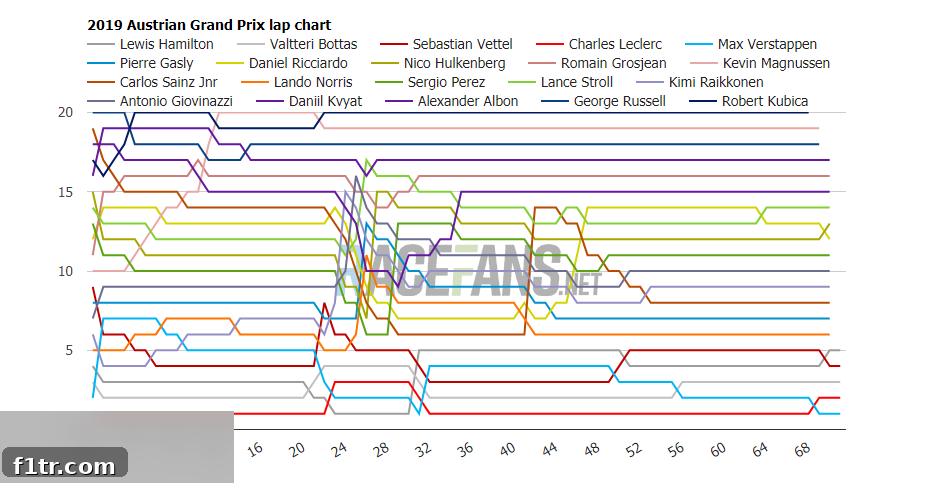
2019 Austrian Grand Prix Lap Chart
This chart visually represents the position of each driver on every lap of the race. It’s a dynamic illustration of how fortunes changed, particularly highlighting Verstappen’s incredible ascent and Sainz’s consistent progress through the pack.
Go ad-free for just £1 per month>> Find out more and sign up
2019 Austrian Grand Prix Race Chart
This chart illustrates the gaps between each driver relative to the leader’s average lap time, offering insights into who was gaining or losing ground throughout the Grand Prix. Very large gaps are omitted for clarity, focusing on the competitive clusters and key battles.
Position Change: A Tale of Gains and Losses
The final positions reveal the true movers and shakers of the race. Carlos Sainz Jnr’s remarkable gain of 11 places stands out as the highest of the season. Sebastian Vettel also showcased strong recovery, gaining 5 positions from his starting grid slot. Conversely, Kevin Magnussen experienced the biggest drop, losing 9 positions from his qualifying effort, highlighting Haas’s struggles with race pace. Romain Grosjean also saw a significant regression of 5 places.
| Driver | Start position | Lap one position change | Race position change |
|---|---|---|---|
| Lewis Hamilton | 4 | 1 | -1 |
| Valtteri Bottas | 3 | 1 | 0 |
| Sebastian Vettel | 9 | 3 | 5 |
| Charles Leclerc | 1 | 0 | -1 |
| Max Verstappen | 2 | -5 | 1 |
| Pierre Gasly | 8 | 0 | 1 |
| Daniel Ricciardo | 12 | -2 | 0 |
| Nico Hulkenberg | 15 | 3 | 2 |
| Romain Grosjean | 11 | -4 | -5 |
| Kevin Magnussen | 10 | 0 | -9 |
| Carlos Sainz Jnr | 19 | 2 | 11 |
| Lando Norris | 5 | 0 | -1 |
| Sergio Perez | 13 | 2 | 2 |
| Lance Stroll | 14 | 1 | 0 |
| Kimi Raikkonen | 6 | 2 | -3 |
| Antonio Giovinazzi | 7 | -2 | -3 |
| Daniil Kvyat | 16 | -3 | -1 |
| Alexander Albon | 18 | 0 | 3 |
| George Russell | 20 | 0 | 2 |
| Robert Kubica | 17 | 1 | -3 |
2019 Austrian Grand Prix Lap Times
A comprehensive view of all lap times recorded by the drivers during the race, excluding very slow laps. This data highlights consistent performers, those who struggled, and moments of exceptional pace from individual drivers, such as Verstappen’s late-race surge.
Go ad-free for just £1 per month>> Find out more and sign up
2019 Austrian Grand Prix Fastest Laps
Each driver’s fastest lap provides a snapshot of ultimate car performance and driver capability at different stages of the race. Max Verstappen not only won the race but also set the fastest lap, underscoring the dominant performance of his Red Bull-Honda package in the latter half of the Grand Prix. Sebastian Vettel and Charles Leclerc followed closely, demonstrating Ferrari’s inherent speed, even if strategy didn’t always play in their favour. Carlos Sainz Jnr also features prominently here, showcasing his car’s potential and his own ability to extract maximum performance.
| Rank | Driver | Car | Fastest lap | Gap | On lap |
|---|---|---|---|---|---|
| 1 | Max Verstappen | Red Bull-Honda | 1’07.475 | 60 | |
| 2 | Sebastian Vettel | Ferrari | 1’07.676 | 0.201 | 62 |
| 3 | Charles Leclerc | Ferrari | 1’07.994 | 0.519 | 58 |
| 4 | Daniel Ricciardo | Renault | 1’08.019 | 0.544 | 65 |
| 5 | Lewis Hamilton | Mercedes | 1’08.050 | 0.575 | 69 |
| 6 | Carlos Sainz Jnr | McLaren-Renault | 1’08.117 | 0.642 | 53 |
| 7 | Valtteri Bottas | Mercedes | 1’08.565 | 1.090 | 53 |
| 8 | Lando Norris | McLaren-Renault | 1’08.699 | 1.224 | 69 |
| 9 | Pierre Gasly | Red Bull-Honda | 1’08.790 | 1.315 | 63 |
| 10 | Kevin Magnussen | Haas-Ferrari | 1’08.903 | 1.428 | 69 |
| 11 | Alexander Albon | Toro Rosso-Honda | 1’08.946 | 1.471 | 59 |
| 12 | Romain Grosjean | Haas-Ferrari | 1’08.987 | 1.512 | 56 |
| 13 | Antonio Giovinazzi | Alfa Romeo-Ferrari | 1’09.051 | 1.576 | 57 |
| 14 | Sergio Perez | Racing Point-Mercedes | 1’09.061 | 1.586 | 67 |
| 15 | Kimi Raikkonen | Alfa Romeo-Ferrari | 1’09.126 | 1.651 | 57 |
| 16 | Nico Hulkenberg | Renault | 1’09.248 | 1.773 | 59 |
| 17 | Lance Stroll | Racing Point-Mercedes | 1’09.288 | 1.813 | 57 |
| 18 | Daniil Kvyat | Toro Rosso-Honda | 1’09.498 | 2.023 | 58 |
| 19 | George Russell | Williams-Mercedes | 1’09.926 | 2.451 | 52 |
| 20 | Robert Kubica | Williams-Mercedes | 1’10.964 | 3.489 | 55 |
Advert | Become a RaceFans supporter andgo ad-free
2019 Austrian Grand Prix Tyre Strategies
Tyre strategy was paramount in the Austrian Grand Prix. The C4 (Soft), C3 (Medium), and C2 (Hard) compounds were in play, and teams adopted varied approaches. Verstappen’s winning strategy involved a long first stint on the C3s before switching to the C2s for an aggressive final push. Ferrari and Mercedes, on the other hand, opted for earlier stops and often used the softer C4s initially, leading to different degradation profiles and strategic windows. Sebastian Vettel notably employed a two-stop strategy, attempting to maximize tyre performance.
| Stint 1 | Stint 2 | Stint 3 | |
|---|---|---|---|
| Max Verstappen | C3 (31) | C2 (40) | |
| Charles Leclerc | C4 (22) | C2 (49) | |
| Valtteri Bottas | C3 (21) | C2 (50) | |
| Sebastian Vettel | C4 (21) | C2 (29) | C4 (21) |
| Lewis Hamilton | C3 (30) | C2 (41) | |
| Lando Norris | C4 (25) | C3 (45) | |
| Pierre Gasly | C4 (25) | C2 (45) | |
| Carlos Sainz Jnr | C3 (41) | C2 (29) | |
| Kimi Raikkonen | C4 (23) | C2 (47) | |
| Antonio Giovinazzi | C4 (24) | C2 (46) | |
| Sergio Perez | C3 (28) | C2 (42) | |
| Daniel Ricciardo | C3 (46) | C4 (24) | |
| Nico Hulkenberg | C3 (26) | C2 (44) | |
| Lance Stroll | C3 (25) | C2 (45) | |
| Alexander Albon | C3 (35) | C2 (35) | |
| Romain Grosjean | C3 (34) | C2 (36) | |
| Daniil Kvyat | C3 (32) | C2 (38) | |
| George Russell | C3 (27) | C2 (42) | |
| Kevin Magnussen | C4 (11) | C2 (51) | C4 (7) |
| Robert Kubica | C3 (19) | C2 (49) |
Go ad-free for just £1 per month>> Find out more and sign up
2019 Austrian Grand Prix Pit Stop Times
The speed and efficiency of pit stops can make or break a race, and Austria 2019 was no exception. Red Bull demonstrated its prowess with Max Verstappen’s stop being the fastest of the race, a critical factor in his comeback. McLaren also performed well, ensuring Carlos Sainz Jnr’s rapid progression was aided by efficient tyre changes. Conversely, Lewis Hamilton’s lengthy stop, due to a damaged front wing requiring a replacement, severely impacted his race, illustrating how even a small delay can have significant consequences in Formula 1.
| Driver | Team | Pit stop time | Gap | On lap | |
| 1 | Max Verstappen | Red Bull | 21.110 | 31 | |
| 2 | Alexander Albon | Toro Rosso | 21.225 | 0.115 | 35 |
| 3 | Carlos Sainz Jnr | McLaren | 21.266 | 0.156 | 41 |
| 4 | Robert Kubica | Williams | 21.525 | 0.415 | 19 |
| 5 | Lando Norris | McLaren | 21.547 | 0.437 | 25 |
| 6 | Antonio Giovinazzi | Alfa Romeo | 21.672 | 0.562 | 24 |
| 7 | Kimi Raikkonen | Alfa Romeo | 21.709 | 0.599 | 23 |
| 8 | Charles Leclerc | Ferrari | 21.878 | 0.768 | 22 |
| 9 | Lance Stroll | Racing Point | 21.982 | 0.872 | 25 |
| 10 | Nico Hulkenberg | Renault | 21.985 | 0.875 | 26 |
| 11 | Pierre Gasly | Red Bull | 22.239 | 1.129 | 25 |
| 12 | Sebastian Vettel | Ferrari | 22.251 | 1.141 | 50 |
| 13 | Romain Grosjean | Haas | 22.265 | 1.155 | 34 |
| 14 | Daniel Ricciardo | Renault | 22.305 | 1.195 | 46 |
| 15 | Kevin Magnussen | Haas | 22.309 | 1.199 | 62 |
| 16 | Sergio Perez | Racing Point | 22.330 | 1.220 | 28 |
| 17 | Valtteri Bottas | Mercedes | 22.552 | 1.442 | 21 |
| 18 | George Russell | Williams | 22.772 | 1.662 | 27 |
| 19 | Kevin Magnussen | Haas | 23.243 | 2.133 | 11 |
| 20 | Daniil Kvyat | Toro Rosso | 25.091 | 3.981 | 32 |
| 21 | Sebastian Vettel | Ferrari | 25.236 | 4.126 | 21 |
| 22 | Lewis Hamilton | Mercedes | 30.067 | 8.957 | 30 |
Related 2019 Austrian Grand Prix Content
- 2019 Austrian Grand Prix Star Performers
- Top ten pictures from the 2019 Austrian Grand Prix
- Leclerc denied again as Verstappen’s hard racing gives Red Bull home win
- Six wins and no pole for Verstappen, two poles and no win for Leclerc
- Paddock Diary: Austrian Grand Prix day four
Browse all 2019 Austrian Grand Prix articles