High-Voltage Scare: Renault Raises FIA Concerns After Marshals Handle Live F1 Car Without Gloves
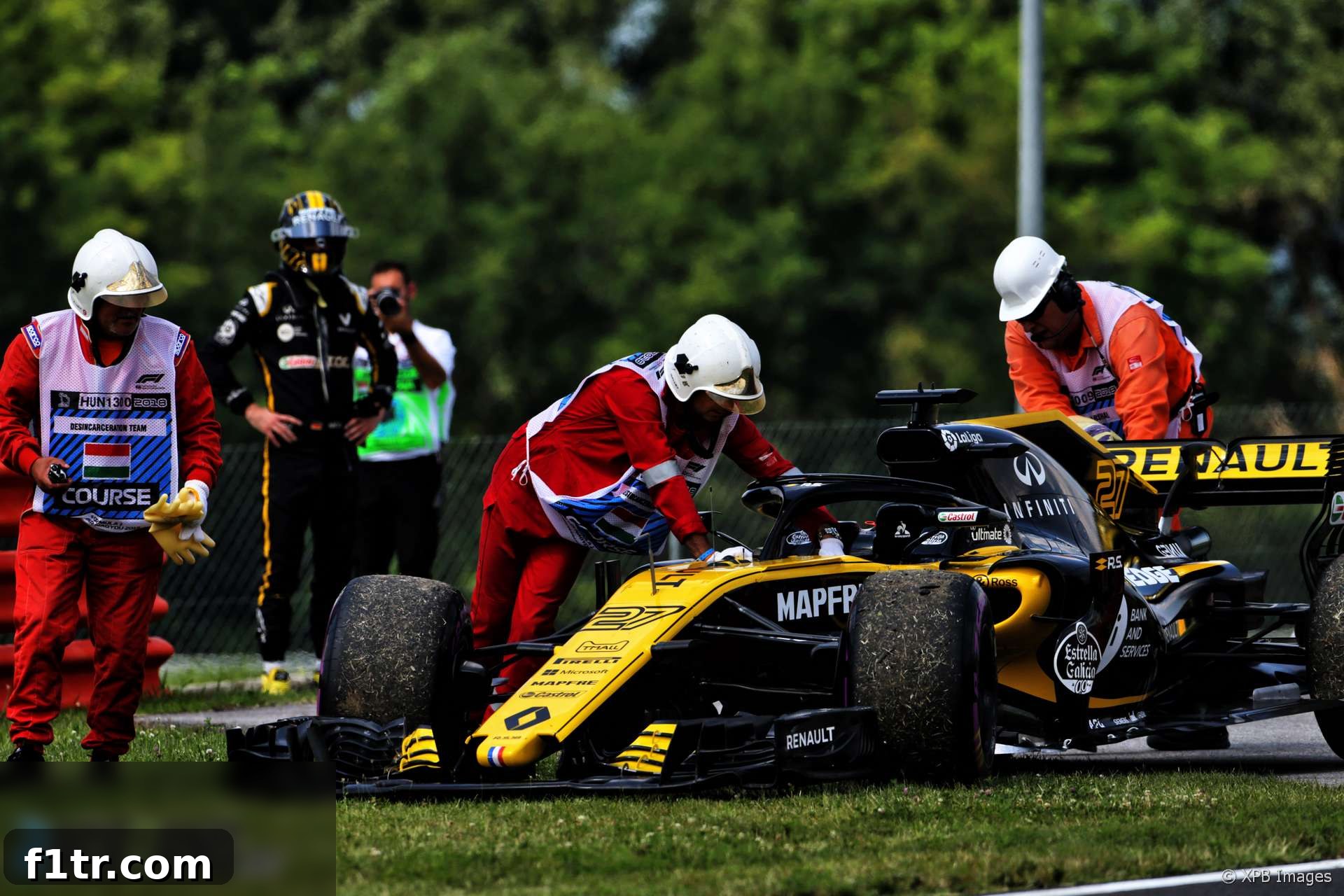
A recent incident during a Formula 1 practice session in Hungary cast a stark spotlight on the critical importance of safety protocols, particularly concerning the handling of high-voltage F1 cars. Renault formally lodged concerns with the FIA after marshals were observed interacting with Nico Hulkenberg’s stricken Formula 1 car without the necessary protective gloves, following a complete electrical failure.
The incident occurred during the first practice session when a short circuit within Hulkenberg’s RS18 energy store led to a total electrical shutdown of the vehicle. This left the Renault team in a precarious position, unable to ascertain whether the car remained electrically live and posed a danger to anyone who might come into contact with it.
Advert | Become a Supporter & go ad-free
The Immediate Danger: Hulkenberg’s Quick Exit and Marshal Intervention
Recognizing the inherent risks associated with an electrical malfunction in modern F1 machinery, Nico Hulkenberg swiftly exited his car, creating distance to avoid any potential electric shock. However, as marshals promptly arrived at the scene to assist with the recovery of the vehicle, Renault personnel immediately noticed a concerning detail: some of the marshals were not wearing the required protective gloves. This alarming observation prompted Renault to alert FIA Race Director Charlie Whiting without delay.
Nick Chester, Renault’s technical director at the time, recounted the tense moments: “The marshals dived in straight away and started pushing the car. We got on the radio to Charlie [Whiting] and said ‘look, we don’t know what state the car’s in because everything died completely and we have got no data’.” Chester added, with a touch of relief, “But the marshals were already pushing it around by then. They lived, so it wasn’t live…” While the incident ultimately concluded without injury, it underscored a significant lapse in safety adherence that could have had severe consequences.
FIA’s Strict Directives: The Imperative of Protective Gloves
Charlie Whiting, the late FIA Race Director, confirmed the unequivocal standing regulations regarding marshal safety. He emphasized that marshals are under strict instructions to wear gloves rated to withstand charges of up to 1,000 volts whenever they handle Formula 1 cars that have stopped on track. This mandate is not conditional; it is a fundamental precautionary measure.
“If a car stops, they don’t stop to see what it’s like then put their gloves on if necessary,” Whiting explained, clarifying the continuous nature of the requirement. “They should wear them all the time, that’s our instruction. You can’t always be sure whether the systems are working correctly so as a precautionary measure they should always all be wearing them.” This highlights the FIA’s commitment to a ‘better safe than sorry’ approach, acknowledging that the complex electrical systems of modern F1 cars can present unpredictable hazards.
Advert | Become a RaceFans supporter andgo ad-free
Understanding the High-Voltage World of Modern F1 Cars
The incident serves as a crucial reminder of the inherent dangers lurking beneath the sleek bodywork of a contemporary Formula 1 car. Modern F1 power units, incorporating sophisticated Energy Recovery Systems (ERS), operate at incredibly high voltages. Components such as the MGU-K (Motor Generator Unit – Kinetic), MGU-H (Motor Generator Unit – Heat), and the main battery pack can store and deliver electrical energy at levels up to 1000 volts. This voltage is more than enough to deliver a fatal electric shock. Unlike the simpler, purely combustion-engined F1 cars of yesteryear, today’s hybrids are intricate machines bristling with electrical power, demanding a heightened level of safety awareness from all personnel involved in their operation and recovery.
The complexity of these systems means that even when a car appears “dead” after a failure, there can still be residual charge in capacitors or other components, or even a fault condition that keeps parts of the system live. This uncertainty is precisely why blanket safety protocols, such as mandatory protective gear for marshals, are absolutely non-negotiable.
Renault’s Rigorous Post-Failure Safety Procedures
Renault’s technical director, Nick Chester, elaborated on the extensive measures teams undertake to ensure a car is safe after an electrical failure, once it has been returned to the garage. “When the guys get the car back and put all their rubber gloves on we secure the area so other people can’t walk in, because other people don’t know what they might be touching,” Chester explained. This initial step creates a safe working perimeter, preventing untrained or unprepared individuals from inadvertently coming into contact with potentially dangerous components.
Securing the Vehicle and Diagnosing the Electrical State
Once the area is secured, specialized technicians, equipped with appropriate personal protective equipment (PPE), commence a meticulous diagnostic process. “We make that area is secure and once we’ve got the floor off and got in there we can start metering things to see what’s live, what’s left in the energy store and then you know what you’re going to do from there,” Chester detailed. This involves using specialized metering devices to accurately measure voltage levels across various electrical components, identifying any areas that remain charged or problematic. Only after a thorough assessment and confirmation of electrical safety can further work proceed.
The Challenges of Handling a Damaged Energy Store
A damaged energy store, like the one in Hulkenberg’s RS18, presents a unique set of challenges. Discharging such a unit safely and quickly is often impractical during a race weekend. “Normally we’d take it out of the car carefully. It’s very hard to discharge, you’d need to put it through quite a bit of resistance to bleed the energy away. That would take a long time so we usually just make sure we’ve uncoupled it carefully and take it away,” Chester explained. This highlights the time-sensitive nature of repairs in Formula 1; teams prioritize safe removal over time-consuming on-site discharge procedures, especially when a replacement unit is available.
Advert | Become a RaceFans supporter andgo ad-free
The Marathon Repair: Getting Hulkenberg Back on Track
Despite the initial fears that the problem was far more severe and potentially session-ending, the Renault team demonstrated remarkable efficiency and resilience. They were able to repair Hulkenberg’s car in time for him to participate in the second practice session later that day, a testament to their skilled workforce and rapid problem-solving capabilities.
The repair job was far from straightforward, as Chester outlined the extensive damage: “It’s quite a long job because when the energy store failed it also damaged some of the looms on the car, and then we had to check out the MGU-K, the MGU-H, meter them all, check they weren’t damaged. At one point we thought we were going to have to change them and then we wouldn’t have run [the rest of the day].” The failure of the energy store had a cascading effect, impacting critical power unit components and the intricate wiring harnesses that connect them.
Furthermore, the incident also affected the car’s transmission. “The guys did a good job because there was a lot of work, it was engine off, check everything, gearbox change as well because when you lose the energy store you lose control of the gearbox and you can damage the gearbox, which we did, so we had to change the gearbox,” Chester confirmed. The interdependency of modern F1 systems means that a failure in one area can quickly compromise others, transforming a seemingly isolated electrical issue into a complex, multi-component repair task requiring significant effort and precision under immense pressure.
Broader Implications for F1 Safety and Continuous Training
The Hulkenberg incident, though resolved without harm, served as a potent reminder of the unyielding need for rigorous safety protocols and continuous training across all facets of Formula 1. From the highly trained pit crew to the volunteer marshals, every individual plays a vital role in ensuring the safety of drivers, personnel, and spectators. The FIA and teams constantly review and update these procedures, learning from every incident, no matter how minor, to further enhance the sport’s already impressive safety record. This commitment to vigilance is paramount in a sport where technological advancements constantly introduce new challenges and potential hazards.
2018 F1 season
- F1 feared “death knell” for Drive to Survive after Ferrari and Mercedes snub
- McLaren staff told us we were “totally crazy” to take Honda engines in 2018 – Tost
- ‘It doesn’t matter if we start last’: How Red Bull’s junior team aided Honda’s leap forward
- Honda’s jet division helped F1 engineers solve power unit problem
- McLaren Racing losses rise after Honda split
Browse all 2018 F1 season articles