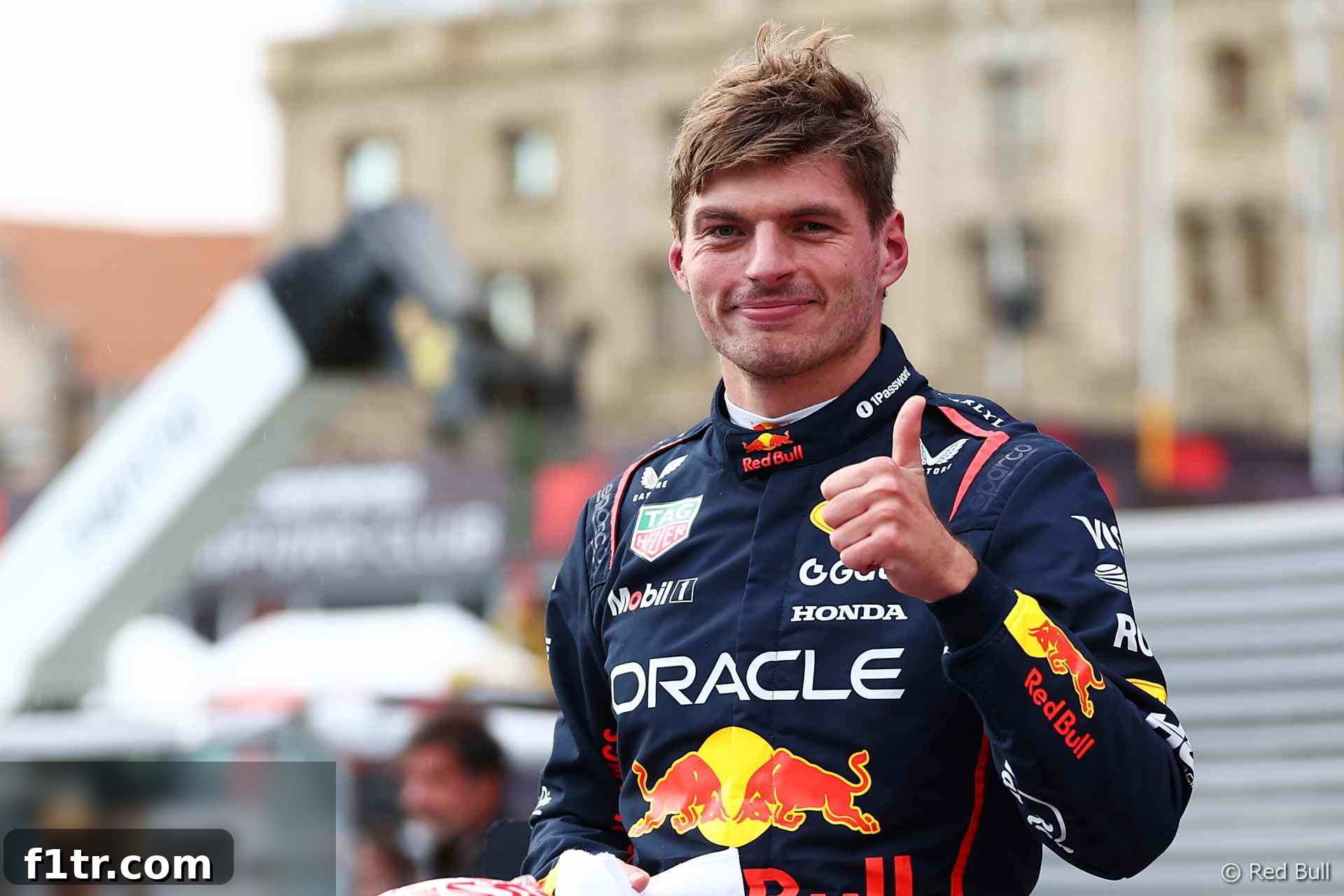
Verstappen’s Masterclass: How Strategic Patience Secured Pole in Chaotic Baku Qualifying
The Azerbaijan Grand Prix qualifying session is often a spectacle of drama and unpredictability, but the recent session reached new heights of chaos. Amidst multiple red flags, fierce winds, and even fleeting rain showers, one driver stood out for his strategic acumen and unwavering composure: Max Verstappen. The Red Bull driver brilliantly navigated the tumultuous conditions, securing a vital pole position with a meticulously timed final lap, a decision that underscored his strategic brilliance and understanding of the dynamic Baku street circuit.
Verstappen’s approach to the critical Q3 phase was markedly different from some of his rivals. He explained that being one of the last drivers to complete a flying lap made perfect sense for him, as he perceived he had “little to lose” if the session was prematurely halted by yet another incident. This calculated risk paid off handsomely, placing him at the front of the grid for what promises to be an exhilarating race.
The High-Stakes Q3: A Game of Risk and Reward
The final segment of qualifying, Q3, was a pressure cooker, intensified by the preceding six red flags that had punctuated the earlier sessions. As the clock ticked down, eight elite drivers prepared for their ultimate bids for pole. Each team faced a critical decision: when to send their driver out. McLaren’s Lando Norris, a formidable rival, opted to be the very first driver out on track for his crucial Q3 run. While his team’s intention was likely to ensure he had a guaranteed opportunity to set a time, given the session’s history of interruptions, Norris later candidly admitted that this decision was a “mistake.”
Norris’s early run saw him complete his lap while track conditions were still evolving. Unfortunately for him, those who followed benefited from what is known as ‘track evolution’ – the circuit becoming progressively faster as more cars lay down rubber and clean the surface. This effect was particularly pronounced in Baku, where the circuit is notoriously ‘green’ at the start of sessions. Consequently, Norris, who was the first to set a time, found himself steadily demoted down the order, ultimately finishing in seventh place. Conversely, Verstappen, who was the seventh driver to complete his flying lap, reaped the rewards of this improving track, seizing pole position with a stunning effort. His Red Bull teammate, Yuki Tsunoda, followed shortly after, further benefiting from the evolving conditions.
Verstappen’s Strategic Insight: Leveraging Track Evolution and Mitigating Risk
Verstappen’s rationale for running late was not solely based on gaining from track evolution, although that was a significant factor. He also considered the extraordinary number of red flags. “It wouldn’t really matter too much,” he explained, “because I think if anyone would have crashed, then there would have been no laps for the people that didn’t have a lap.” This astute observation highlighted the precarious nature of the session. If another crash had occurred towards the very end, effectively red-flagging the session for good, many drivers, including Verstappen, would have been unable to complete their final attempts. However, given his provisional fourth place at the time the session resumed, behind three drivers who had already set times and ahead of Norris, he understood that the potential upside of running later (better track conditions and a clearer run) outweighed the slim chance of not completing a lap at all.
A crucial element of Verstappen’s strategy also involved avoiding being the lead car on track. “I just didn’t want to be first because you lose a bit to the line,” he stated. This refers to the significant advantage of a ‘slipstream’ on Baku’s incredibly long main straight. By tucking in behind another car, a driver can benefit from reduced aerodynamic drag, gaining crucial tenths of a second. Running first means foregoing this advantage entirely. By choosing to run almost at the back, Verstappen positioned himself perfectly to potentially exploit a slipstream if available, while also securing the prime real estate on a rapidly improving track. “So that meant that we were almost at the back, but that was okay. That was a call that we made,” he concluded, emphasizing the deliberate nature of this strategic decision.
Battling the Elements: Wind, Rain, and Red Flags
Beyond the strategic intricacies, drivers faced an exceptionally challenging environment. The repeated interruptions meant the qualifying session stretched to nearly two hours, a testament to the numerous incidents that plagued the track. Adding to the complexity were the severe weather conditions: powerful gusts of wind relentlessly buffeted the cars, and sporadic light rain showers further complicated tire choices and grip levels. This combination of factors made the session a true test of nerve and skill.
“It was just a very long qualifying in general with all the red flags, so you never got into a rhythm,” Verstappen reflected. Maintaining focus and getting into a flow state, which is crucial for optimal performance, proved incredibly difficult. The constant stops and starts meant drivers were often cooling down, then having to rapidly warm up themselves and their tires again. “Trying to complete laps was already difficult enough with what was going on,” he added. A particularly challenging aspect was “getting the tyres in the window on your warm-up lap,” a critical process for ensuring the tires provide maximum grip. Around Baku’s demanding layout, with its mix of low-speed corners and high-speed sections, achieving optimal tire temperature is a fine art, made even harder by the stop-start nature of the session and the varying atmospheric conditions.
The Unforgiving Baku Circuit: A True Driver’s Challenge
The Baku City Circuit is renowned for its unique and formidable challenges even in ideal conditions. It combines an incredibly tight, technical castle section with ultra-fast straights, demanding a complex compromise in car setup and immense precision from drivers. Verstappen highlighted how the natural difficulty of the track was amplified by the adverse weather. “This track is already hard enough without anything,” he stated. “With the strong winds that we had today the car was moving around a lot — understeer, oversteer in different places, even on the straight, going left to right.”
The strong crosswinds at high speed can make a car incredibly unstable, leading to sudden shifts from understeer (where the front of the car loses grip) to oversteer (where the rear loses grip), even on the supposedly straight sections where drivers expect stability. This unpredictability demanded constant micro-corrections and extraordinary car control. “So, to basically nail everything, but also [with] the big interruptions that we had, it was just very tricky today. But luckily, I think we did quite well,” Verstappen concluded with a hint of relief, acknowledging the immense effort required to extract performance in such a challenging environment.
Ultimately, Verstappen’s pole position was a testament to his exceptional talent, his team’s strategic foresight, and his ability to remain calm and focused amidst the most chaotic of F1 qualifying sessions. It was a masterclass in strategic patience and adaptability, setting the stage for what promises to be a thrilling race where starting from the front could be a decisive advantage.
Miss nothing from RaceFans
Get a daily email with all our latest stories – and nothing else. No marketing, no ads. Sign up here:
2025 Azerbaijan Grand Prix
- Sainz praises “hardest working” engineer who wept after his Baku podium
- McLaren had best car for “95% of races” but Red Bull have caught up – Norris
- Norris couldn’t close a 69-point gap in 14 rounds. Verstappen has to do it in seven
- “That’s not what we discussed”: Ocon’s complaint about Haas’s team orders in Baku
- Verstappen has led more laps than Norris in 2025: Azerbaijan GP stats
Browse all 2025 Azerbaijan Grand Prix articles