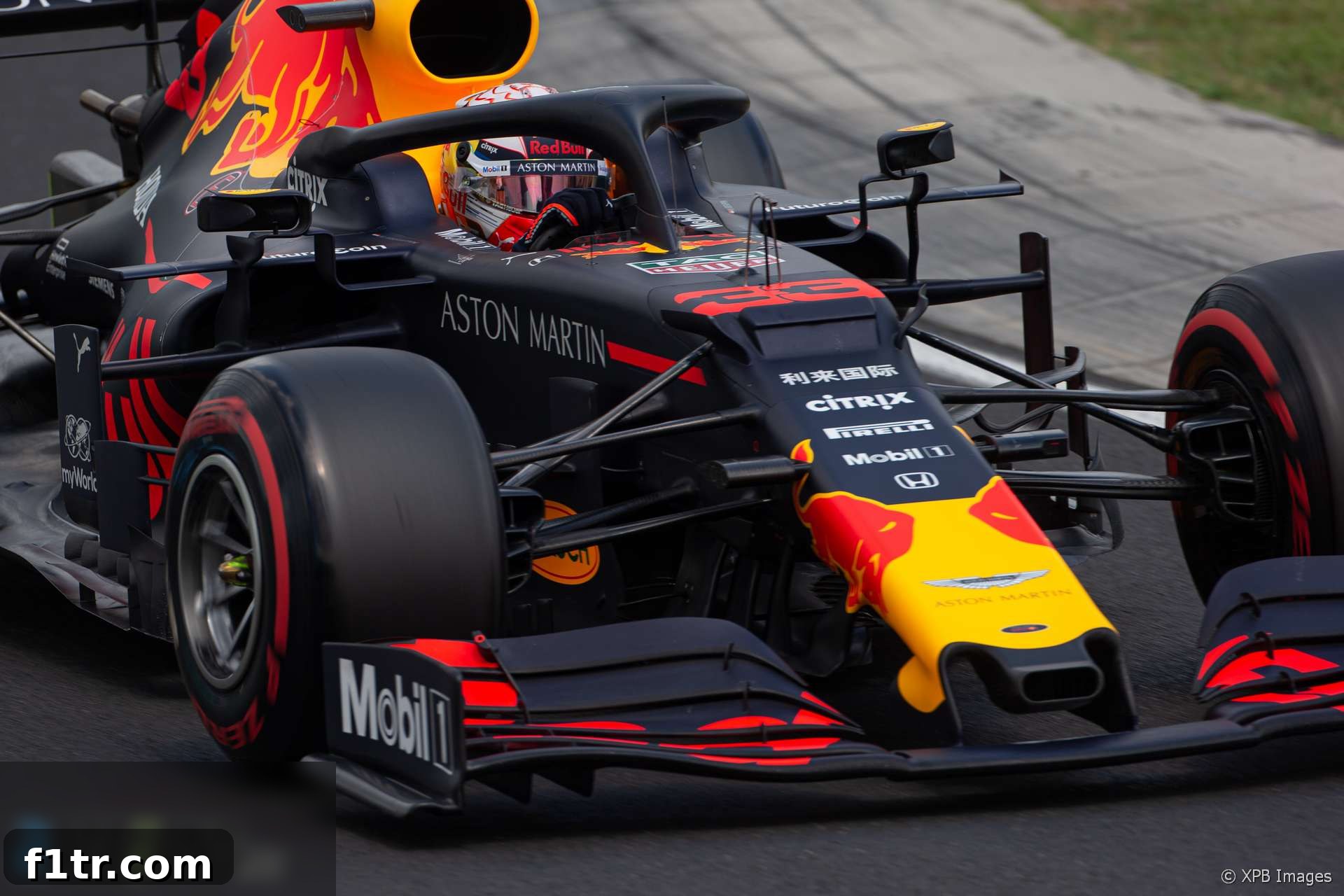
Max Verstappen on Pole at Hungaroring: Analyzing Red Bull’s Battle Against Mercedes’ Strategic Threat
Having claimed a sensational pole position at the tight and twisty Hungaroring, a circuit where track position is paramount and overtaking opportunities are notoriously scarce, Max Verstappen stands as the undeniable favourite for victory in Sunday’s Hungarian Grand Prix. His blistering qualifying lap not only showcased Red Bull-Honda’s impressive single-lap pace but also solidified his position at the front of the grid, a crucial advantage on this demanding track often dubbed “Monaco without walls.” However, despite this strong starting point, the young Dutchman and his Red Bull team are far from assured of an easy win, facing a formidable strategic challenge from the Mercedes-AMG Petronas duo lining up directly behind him.
The Hungaroring Challenge: Pole Position’s Strategic Edge
The Hungaroring circuit, nestled just outside Budapest, is a unique beast in the Formula 1 calendar. Its narrow, winding layout, characterised by a continuous series of corners and short straights, puts a premium on aerodynamic downforce and driver precision. Overtaking is exceptionally difficult, meaning that qualifying position often dictates the outcome of the race. Historically, a significant percentage of Hungarian Grand Prix winners have started from pole position, underscoring the critical importance of Verstappen’s Saturday achievement. The long 600-meter run down to Turn 1 after the start is arguably the best, if not the only, genuine overtaking zone on the entire lap, making the initial moments of the race intensely strategic and potentially race-defining.
Verstappen’s pole position is a testament to Red Bull’s consistent improvement throughout the season. The synergy between the chassis and the Honda power unit has seen them become a potent force, particularly in recent races. Yet, the Hungaroring’s demanding nature also exposes any subtle weaknesses, and Mercedes, with their championship pedigree and a pair of equally talented drivers, are poised to exploit any chinks in Red Bull’s armour.
Verstappen’s Vulnerabilities: A Dual Threat from Mercedes
While Verstappen enjoys the prime starting spot, there are two principal areas where the Red Bull driver could find himself vulnerable to the concerted efforts of the Mercedes pairing of Valtteri Bottas and Lewis Hamilton. These vulnerabilities, if not meticulously managed, could turn a seemingly straightforward victory into a complex strategic battle against two of the sport’s most experienced and tactically astute competitors.
The Critical Race Start: Navigating the Gauntlet to Turn 1
The first significant challenge for Verstappen will undoubtedly come at the start of the race. His getaways from the grid have been a noticeable weak point in recent Grand Prix weekends. Illustratively, in Austria, he lost five positions on the opening lap before heroically recovering to win. Similarly, in Germany, he conceded two places at the start, only to fight his way back through the field for another impressive victory. While his ability to recover positions after a less-than-ideal start is undeniable and speaks volumes about his race craft and the car’s performance, replicating such comebacks will be exceedingly difficult, if not impossible, at the Hungaroring.
The unique characteristics of the Hungarian circuit, with its long run down to a tight first corner, transform the start into a high-stakes lottery. Verstappen’s Friday practice sessions saw him diligently working on simulated race starts, a clear indication that Red Bull is acutely aware of this potential weakness. Expect to see him conducting additional reconnaissance runs on Sunday, practicing his clutch release and acceleration to perfection. A sub-optimal start at the Hungaroring could see him quickly swamped by the Mercedes cars, immediately negating his hard-earned pole position advantage.
Even with a reasonable launch, Verstappen will have to contend with the superior straight-line speed of the Mercedes power units on the 600-meter sprint to Turn 1. This significant run-up provides a prime opportunity for slipstreaming and outright pace comparisons. Red Bull, while excellent in corners, often concedes a few kilometers per hour to Mercedes on the straights. Verstappen’s extensive repertoire of defensive moves, honed through countless wheel-to-wheel battles, will be crucial in fending off any aggressive challenges from Bottas and Hamilton in the opening seconds of the race.
Mercedes’ Strategic Chess Game: The Two-Car Advantage
Beyond the initial start, the strategic landscape of the race presents another critical vulnerability for Verstappen. While Red Bull boasts a stellar reputation for being one of the most strategically sharp teams in the pit lane, renowned for their rapid pit stops, their tactical prowess will be tested to its limits on Sunday due to the absence of a viable ‘wingman’. With Pierre Gasly typically struggling to match the pace of the front-running cars and often finding himself mired further down the field, Verstappen lacks the crucial support that a second car can offer in a direct fight against a two-pronged attack.

Lewis Hamilton, starting third behind his teammate Valtteri Bottas, openly acknowledged this strategic opportunity for Mercedes. “We’re in a good position in terms of working as a team tomorrow,” he stated. “We’re in a fortunate position, potentially, if we can hold on to Max to be able to work together to pull him closer to us and give him a bit of a run for his money.” This highlights Mercedes’ intent to use both cars to pressure Verstappen, making his race significantly more complex.
Hamilton further elaborated on the disadvantage of being a sole front-runner: “It’s a little bit harder when you’re on your own at the front in the team, because you can come under attack from undercuts and all this sort of thing. We’ll see how that plays out but we’ve got a long run down to Turn 1 so hopefully we will have a nice long battle down there and then after that it’s down to team tactics.” His comments perfectly encapsulate the strategic chess match that awaits. A driver leading alone is exposed to various tactical maneuvers, particularly the ‘undercut’, where an earlier pit stop on fresh tyres can allow a chasing car to gain track position before the leader reacts.
The classic approach for Mercedes, and one they have perfected over the years, will be to split their strategy: pitting one driver early and the other one later. The first driver, likely Bottas given his front-row start, will have the opportunity to get ahead of Verstappen by stopping for new tyres first and executing a rapid ‘undercut’. This maneuver aims to gain track position by exploiting the superior grip of fresh rubber during the initial laps after a pit stop, before the leading car has a chance to respond. The second driver, in this scenario Hamilton, would then be well-placed to capitalize on any unforeseen circumstances, such as a Safety Car or Virtual Safety Car period, which could allow for a ‘free’ pit stop or a significant advantage by running longer on older tyres and then attacking harder later in the race with fresher rubber. This dual strategy forces Red Bull into a defensive reaction, often compromising their optimal race plan.
Moreover, the Hungaroring is known for its high tire degradation, particularly with hotter track conditions. Managing the tire wear effectively will be paramount, and having two cars with different strategies provides Mercedes with a significant data advantage and flexibility. They can observe how each tire compound performs under race conditions with one car before committing the other, effectively hedging their bets. Verstappen, on the other hand, will be on a more singular path, making his tire management and pit stop timing absolutely critical.
Race Pace & Unforeseen Factors: The Ferrari Wildcard and Track Conditions
Of course, all these strategic assumptions hinge on Mercedes possessing sufficient race pace to consistently challenge Verstappen. If the Red Bull-Honda package proves to be genuinely faster over a full race stint, then even the most intricate Mercedes strategy might fail to dislodge the Dutchman. Should Verstappen indeed secure his third victory in four races, it would emphatically underline Red Bull-Honda’s emergence as a major, consistent threat to the world champions, not just on individual qualifying laps but across entire Grand Prix distances.
Adding another layer of uncertainty to the race pace predictions are the challenging conditions experienced earlier in the weekend. Rain on Friday significantly limited dry running, and a final practice session that was disrupted due to oil on the track made it harder than usual for teams to gather comprehensive data on long-run performance and tire degradation. This lack of clear data means teams head into Sunday with more unknowns than usual, potentially leading to varied strategies and unexpected outcomes.
The Ferrari drivers, Charles Leclerc and Sebastian Vettel, starting fourth and fifth respectively, have expressed concerns that they aren’t quite on the same level as Mercedes and the leading Red Bull in terms of outright race pace. However, the forecast for hotter conditions on race day could potentially play into their hands. Ferrari has historically shown strong performance in high-temperature environments, and their tire management might prove more effective than their rivals in such circumstances. A strong performance from Ferrari could complicate Mercedes’ strategic options even further, as they would also need to defend against the Scuderia’s challenge while trying to hunt down Verstappen.
A Deep Dive into Qualifying: Performance Analysis
Max Verstappen’s pole lap of 1’14.572 was a masterclass, narrowly edging out Valtteri Bottas by just 0.018 seconds, highlighting the incredible tightness at the front. Lewis Hamilton wasn’t far behind, underscoring Mercedes’ raw speed. Ferrari showed glimpses of pace, but ultimately couldn’t match the front two teams. The qualifying results provide a clear snapshot of the pecking order and the challenges ahead for Sunday.
Full Qualifying Results
| Driver | Car | Q1 | Q2 (vs Q1) | Q3 (vs Q2) | ||
| 1 | Max Verstappen | Red Bull | 1’15.817 | 1’15.573 (-0.244) | 1’14.572 (-1.001) | |
| 2 | Valtteri Bottas | Mercedes | 1’16.078 | 1’15.669 (-0.409) | 1’14.590 (-1.079) | |
| 3 | Lewis Hamilton | Mercedes | 1’16.068 | 1’15.548 (-0.520) | 1’14.769 (-0.779) | |
| 4 | Charles Leclerc | Ferrari | 1’16.337 | 1’15.792 (-0.545) | 1’15.043 (-0.749) | |
| 5 | Sebastian Vettel | Ferrari | 1’16.452 | 1’15.885 (-0.567) | 1’15.071 (-0.814) | |
| 6 | Pierre Gasly | Red Bull | 1’16.716 | 1’16.393 (-0.323) | 1’15.450 (-0.943) | |
| 7 | Lando Norris | McLaren | 1’16.697 | 1’16.060 (-0.637) | 1’15.800 (-0.260) | |
| 8 | Carlos Sainz Jnr | McLaren | 1’16.493 | 1’16.308 (-0.185) | 1’15.852 (-0.456) | |
| 9 | Romain Grosjean | Haas | 1’16.978 | 1’16.319 (-0.659) | 1’16.013 (-0.306) | |
| 10 | Kimi Raikkonen | Alfa Romeo | 1’16.506 | 1’16.518 (+0.012) | 1’16.041 (-0.477) | |
| 11 | Nico Hulkenberg | Renault | 1’16.790 | 1’16.565 (-0.225) | ||
| 12 | Alexander Albon | Toro Rosso | Toro Rosso | 1’16.912 | 1’16.687 (-0.225) | |
| 13 | Daniil Kvyat | Toro Rosso | Toro Rosso | 1’16.750 | 1’16.692 (-0.058) | |
| 14 | Antonio Giovinazzi | Alfa Romeo | Alfa Romeo | 1’16.894 | 1’16.804 (-0.090) | |
| 15 | Kevin Magnussen | Haas | Haas | 1’16.122 | 1’17.081 (+0.959) | |
| 16 | George Russell | Williams | Williams | 1’17.031 | ||
| 17 | Sergio Perez | Racing Point | Racing Point | 1’17.109 | ||
| 18 | Daniel Ricciardo | Renault | Renault | 1’17.257 | ||
| 19 | Lance Stroll | Racing Point | Racing Point | 1’17.542 | ||
| 20 | Robert Kubica | Williams | Williams | 1’18.324 |
Sector Performance Insights
| Driver | Sector 1 | Sector 2 | Sector 3 |
|---|---|---|---|
| Max Verstappen | 27.095 (4) | 26.456 (2) | 21.021 (1) |
| Valtteri Bottas | 27.079 (3) | 26.411 (1) | 21.100 (3) |
| Lewis Hamilton | 27.228 (5) | 26.488 (3) | 21.053 (2) |
| Charles Leclerc | 27.036 (2) | 26.553 (4) | 21.454 (6) |
| Sebastian Vettel | 26.918 (1) | 26.793 (5) | 21.360 (5) |
| Pierre Gasly | 27.330 (8) | 26.809 (6) | 21.169 (4) |
| Lando Norris | 27.284 (7) | 26.905 (9) | 21.565 (8) |
| Carlos Sainz Jnr | 27.279 (6) | 27.013 (10) | 21.560 (7) |
| Romain Grosjean | 27.457 (11) | 26.861 (8) | 21.660 (10) |
| Kimi Raikkonen | 27.361 (9) | 27.107 (12) | 21.571 (9) |
| Nico Hulkenberg | 27.422 (10) | 27.333 (16) | 21.663 (11) |
| Alexander Albon | 27.554 (14) | 27.191 (14) | 21.796 (13) |
| Daniil Kvyat | 27.626 (15) | 27.085 (11) | 21.843 (14) |
| Antonio Giovinazzi | 27.526 (13) | 27.276 (15) | 21.849 (15) |
| Kevin Magnussen | 27.525 (12) | 26.813 (7) | 21.756 (12) |
| George Russell | 27.827 (19) | 27.147 (13) | 22.057 (18) |
| Sergio Perez | 27.674 (17) | 27.478 (18) | 21.957 (16) |
| Daniel Ricciardo | 27.807 (18) | 27.404 (17) | 21.962 (17) |
| Lance Stroll | 27.666 (16) | 27.723 (19) | 22.100 (19) |
| Robert Kubica | 28.026 (20) | 27.896 (20) | 22.390 (20) |
Speed Trap Data: The Power Unit Battle
| Pos | Driver | Car | Engine | Speed (kph/mph) | Gap |
|---|---|---|---|---|---|
| 1 | Sebastian Vettel | Ferrari | Ferrari | 315.6 (196.1) | |
| 2 | Charles Leclerc | Ferrari | Ferrari | 315.2 (195.9) | -0.4 |
| 3 | Antonio Giovinazzi | Alfa Romeo | Ferrari | 313.1 (194.6) | -2.5 |
| 4 | Kimi Raikkonen | Alfa Romeo | Ferrari | 312.6 (194.2) | -3.0 |
| 5 | Lando Norris | McLaren | Renault | 312.1 (193.9) | -3.5 |
| 6 | Nico Hulkenberg | Renault | Renault | 311.7 (193.7) | -3.9 |
| 7 | Daniil Kvyat | Toro Rosso | Honda | 311.2 (193.4) | -4.4 |
| 8 | Alexander Albon | Toro Rosso | Honda | 310.0 (192.6) | -5.6 |
| 9 | Romain Grosjean | Haas | Ferrari | 310.0 (192.6) | -5.6 |
| 10 | Valtteri Bottas | Mercedes | Mercedes | 309.9 (192.6) | -5.7 |
| 11 | Daniel Ricciardo | Renault | Renault | 309.9 (192.6) | -5.7 |
| 12 | Carlos Sainz Jnr | McLaren | Renault | 309.9 (192.6) | -5.7 |
| 13 | Lance Stroll | Racing Point | Mercedes | 309.7 (192.4) | -5.9 |
| 14 | Lewis Hamilton | Mercedes | Mercedes | 309.3 (192.2) | -6.3 |
| 15 | Sergio Perez | Racing Point | Mercedes | 308.8 (191.9) | -6.8 |
| 16 | George Russell | Williams | Mercedes | 308.6 (191.8) | -7.0 |
| 17 | Max Verstappen | Red Bull | Honda | 307.5 (191.1) | -8.1 |
| 18 | Robert Kubica | Williams | Mercedes | 307.2 (190.9) | -8.4 |
| 19 | Pierre Gasly | Red Bull | Honda | 306.6 (190.5) | -9.0 |
| 20 | Kevin Magnussen | Haas | Ferrari | 306.2 (190.3) | -9.4 |
Over to You: Share Your Predictions for the Hungarian Grand Prix
With Max Verstappen starting from pole, but facing a relentless strategic challenge from the Mercedes duo, the 2019 Hungarian Grand Prix promises to be a captivating battle. The unique characteristics of the Hungaroring, coupled with the uncertainties from disrupted practice sessions and the potential wildcard of Ferrari’s race pace in hotter conditions, set the stage for a truly unpredictable Sunday. Will Verstappen hold off the Silver Arrows’ two-pronged attack, or will Mercedes execute a perfect strategy to claim victory? Share your views and predictions on the Hungarian Grand Prix in the comments below.
More from the 2019 Hungarian Grand Prix
- Top ten pictures from the 2019 Hungarian Grand Prix
- 2019 Hungarian Grand Prix Star Performers
- Verstappen can’t stop Hammertime
- Hamilton 10 wins away from Schumacher’s all-time victory record
- Paddock Diary: Hungarian Grand Prix day four
Browse all 2019 Hungarian Grand Prix articles