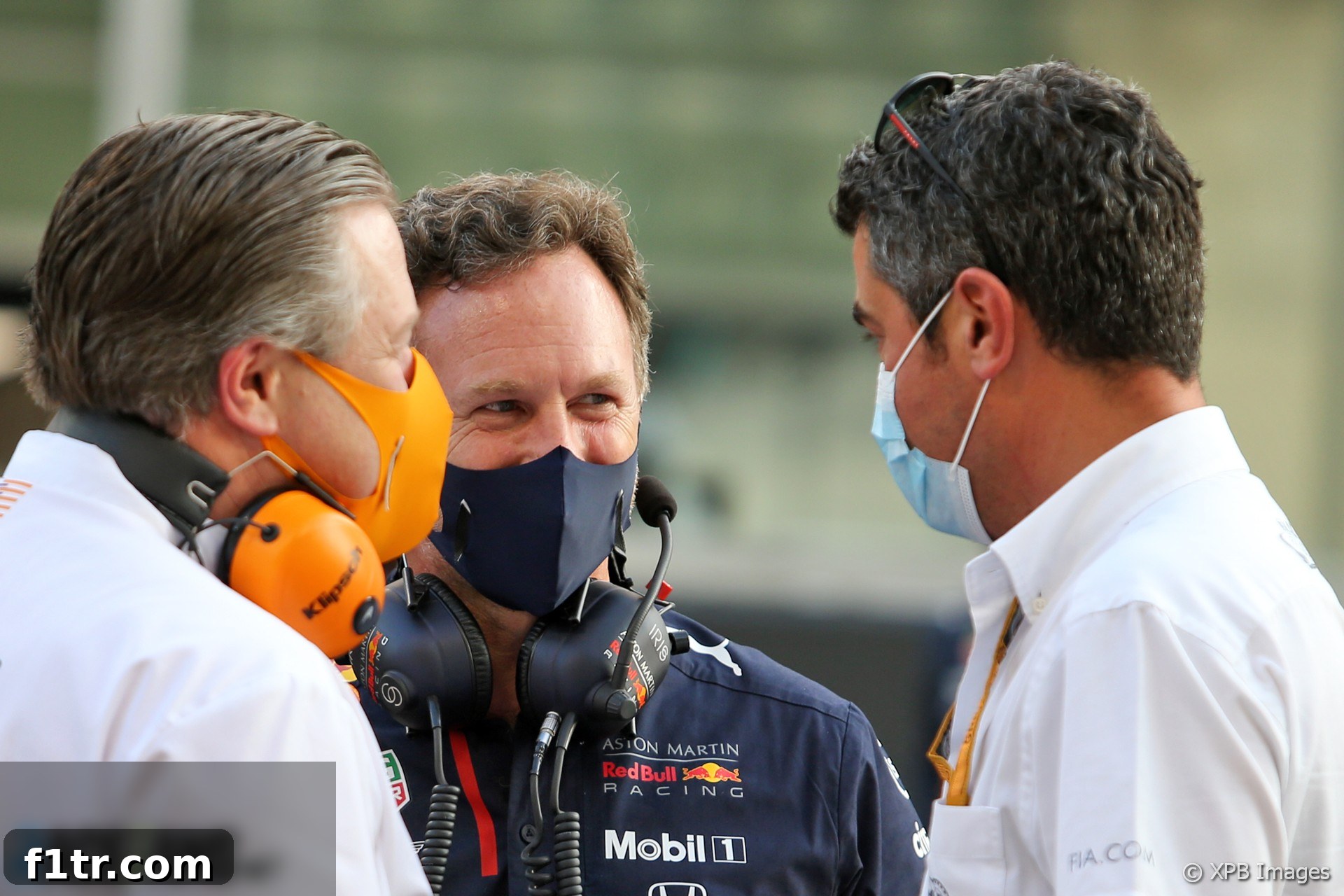
Red Bull Racing Team Principal Christian Horner has voiced strong criticism regarding the FIA’s decision to remove Michael Masi from his role as Formula 1 Race Director. This move followed intense scrutiny and controversy surrounding the dramatic conclusion of the 2021 Abu Dhabi Grand Prix, a race that ultimately decided the championship in favor of Red Bull’s Max Verstappen.
Horner Challenges Masi’s Dismissal and Advocates for Consistency in F1 Officiating
FIA President Mohamed Ben Sulayem confirmed Masi’s departure last week, alongside a series of significant changes to Formula 1 officiating. These included the introduction of a virtual race control room and a new rotational system for the Race Director role. The decision to replace Masi stemmed from accusations that he contravened sporting regulations during the final laps of the Abu Dhabi Grand Prix by allowing only a select group of lapped cars to unlap themselves behind the Safety Car, directly paving the way for Verstappen to overtake Lewis Hamilton on the final lap and secure his maiden world title.
However, Christian Horner has vehemently rejected the notion that Masi acted incorrectly or deserved to be replaced. In a candid interview with TalkSport, Horner described the FIA’s decision as “harsh,” highlighting the immense pressure Masi faced throughout a fiercely contested 2021 season.
“I think that it’s a difficult one, it’s the FIA’s business, but I think it’s harsh,” Horner stated. “He was in a very difficult position last year. We feel that a lot of decisions went against us last year, and I think when you look at what he has at his disposal in terms of resource compared to what the teams have, there’s such a massive, massive difference.”
Horner acknowledged the positive steps taken by the FIA to bolster race control, such as the implementation of a “VAR equivalent” system and the return of experienced personnel like Herbie Blash. Yet, he underscored his belief that the ultimate decision to remove Masi was driven by external forces rather than a fair assessment of his performance. “I just think there was so much pressure put on the removal of Michael; that’s not right. That was my personal feeling,” he added.
The Abu Dhabi Grand Prix: A Tactical Retrospective
The controversy in Abu Dhabi centered on Masi’s application of the Safety Car rules. Critics argued that by not allowing all lapped cars to pass, and then restarting the race with just one lap remaining, Masi created an artificial scenario that unfairly disadvantaged Hamilton, who had been leading comfortably. Mercedes Team Principal Toto Wolff famously declared that Hamilton was “robbed” of the championship. However, Wolff later denied exerting pressure on the FIA for Masi’s removal, asserting that Hamilton would have continued in F1 regardless of Masi’s future.
Horner, however, insisted that Masi adhered to the rules and that the ensuing controversy served as a “smokescreen” to deflect attention from Mercedes’ tactical misjudgments during the race. He argued that Mercedes had two clear opportunities to pit Hamilton for fresh tires under Safety Car conditions but chose not to, leaving him vulnerable to Verstappen, who had the advantage of new soft tires.
“It’s a bit of a smokescreen because, when you look back at that race, Mercedes had two opportunities to pit,” Horner explained. “There was a Virtual Safety Car and there was a Safety Car, and the driver was asking to pit on both times, and they left him out. And that’s what exposed him at the end of the race. Tactically, we got it right on the day, and it’s those small margins.”
Horner elaborated on Red Bull’s swift strategic decision following Nicholas Latifi’s crash in the closing laps. “When the crash came five laps from the end with Nicholas Latifi, we reacted immediately. We got Max in, we pitted him for a new set of tyres. Mercedes left Lewis out on what would become 44-lap-old tyres at the end of their life. And obviously Max had to make that pass on the last lap, which he did.”
From Red Bull’s perspective, the tactical call was pivotal, and Verstappen’s execution was flawless. “I think there’s been a bit of hiding around some of the controversy because the bottom line is tactically we got it right. Max delivered the move and became the world champion, so it was a phenomenal result,” Horner concluded, underscoring his belief that their strategy, rather than any perceived rule breach by Masi, determined the outcome.
Moving Forward: No Apology and the Future of Race Direction
Horner also dismissed suggestions that the FIA should issue an apology to Lewis Hamilton over the handling of the final race. He argued that singling out this incident for an apology would open a Pandora’s box of revisiting numerous contentious decisions made throughout the season.
“You could argue that about 100 different decisions that were made during the course of the year,” Horner stated, citing examples such as the penalties at Silverstone and Jeddah. “Was the penalty at Silverstone big enough? Were the penalties that we got in Jeddah fair? There’s so many things. I think it’s time to turn the page, move on. There’s a new president in the FIA, he’s looking to put a new structure in place and embrace more technology to help support those officials.”
The FIA’s new structure sees the Race Director role shared by WEC Race Director Eduardo Freitas and DTM counterpart Niels Wittich for the 2022 season. However, Horner expressed reservations about this rotational approach, primarily due to concerns about maintaining consistency.
“It’s not something personally I would do, because it would be like rotating the race engineer or the team manager in our team. You sign up, you do all the races. You want that consistency,” Horner remarked. He stressed the importance of a consistent application of the rules across all races, a key demand from drivers and teams alike.
While acknowledging the potential benefits of remote support, Horner highlighted the fundamental challenge facing the FIA: “But if they’re not actually trackside, you hope they’d be supporting them remotely so they’ve got that consistency. The one thing that drivers want is a consistent application of the rules rather than penalties changing from race-to-race. I think that’s the challenge the FIA have got to obviously address this season.”
As Formula 1 enters a new era with revised technical regulations and a restructured race control, the echoes of the 2021 Abu Dhabi Grand Prix continue to resonate. Christian Horner’s steadfast defense of Michael Masi and his critique of the new officiating structure underline the ongoing debate about fairness, consistency, and the immense pressure placed on those governing the pinnacle of motorsport.
2022 F1 season
- Mercedes told me “you’re wrong” about 2022 car’s problems – Hamilton
- FIA confirms all 10 F1 teams complied with 2022 cost cap
- Steiner “not ashamed” of panning “slow” Schumacher in Drive to Survive
- Albon believes year out of F1 improved him as a driver
- Hamilton sees diversity gains in F1 years on from his ‘traumatising’ experience of racism
Browse all 2022 F1 season articles