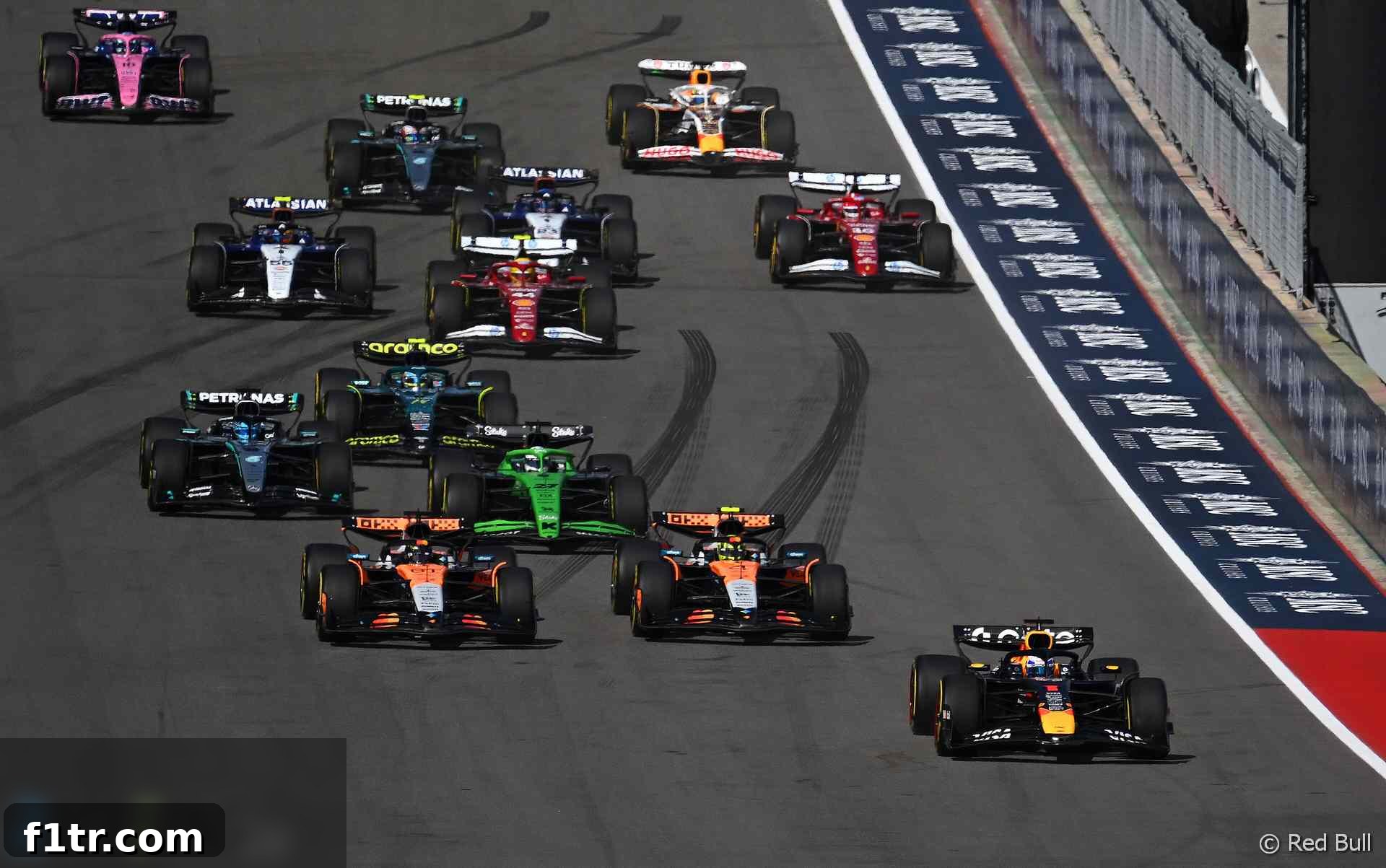
The Circuit of the Americas (COTA) in Austin, Texas, sets the stage for a highly anticipated United States Grand Prix, promising a thrilling spectacle of Formula 1 racing. After a weekend marked by unpredictable conditions and intense competition, all eyes are on Max Verstappen, who secured pole position with a commanding performance in qualifying. His dominant form positions him perfectly to significantly reduce the points gap to the McLaren drivers, Lando Norris and Oscar Piastri, intensifying the championship battle as the season approaches its climax.
However, the journey to the top step of the podium is rarely straightforward in Formula 1. This particular weekend has been a crucible of challenges, with limited practice sessions, a disrupted sprint race, and constantly shifting wind conditions. These variables have compounded the strategic complexity for teams and drivers, hinting at a Grand Prix that could very well produce a myriad of surprises. Even the initial moments of the race, specifically the notoriously challenging first corner, loom large as a potential flashpoint, capable of reshaping the entire narrative before the field has truly settled.
The Dynamic Track: Circuit of the Americas Unveiled
COTA is renowned for its unique layout, a masterclass in modern circuit design that blends high-speed sections with technical, challenging corners. Its signature uphill run to Turn 1 immediately tests a driver’s nerve and precision, followed by a series of fast, sweeping esses reminiscent of Silverstone’s Maggotts-Becketts complex. The track then transitions into a more traditional stadium section, demanding precision through tight turns before unfolding onto long straights. This diverse character makes COTA a true all-rounder, requiring a finely balanced car setup that can excel in both aerodynamic efficiency and mechanical grip. The undulating terrain adds another layer of complexity, demanding constant adaptation from drivers and making line choices critical for optimal pace. It’s a circuit that rewards bravery, precision, and strategic foresight, setting the stage for an enthralling race where every tenth of a second and every tactical decision can make a significant difference.
Weather’s Unpredictable Influence on Race Day
The Texan heat is a formidable opponent in itself, and conditions for today’s Grand Prix are expected to remain hot, though perhaps slightly less intense than Saturday’s qualifying. Temperatures are forecast to exceed 31 degrees Celsius, surpassing last year’s levels. This sustained heat creates a demanding environment for both machines and drivers. A “heat hazard” has been declared, mandating teams to activate their cooling systems to safeguard engine components and brakes, while drivers grapple with the physical toll inside their cockpits. Staying hydrated and managing physical exertion will be paramount for endurance throughout the race.
Beyond the heat, the shifting winds at COTA have emerged as a significant talking point. Yesterday’s qualifying saw several drivers struggle with the capricious gusts, which can dramatically alter a car’s aerodynamic balance and stability, particularly through high-speed corners. George Russell, a driver known for his meticulous approach, highlighted this factor, remarking, “The wind is likely to shift 180 degrees tomorrow which will be interesting.” This drastic change in wind direction will force drivers to adapt their lines, braking points, and car control, potentially creating new overtaking opportunities in some sections while making others far more challenging. The headwind that aided Russell’s Turn 12 attempt in the sprint race, for instance, might become a tailwind, fundamentally changing the approach to that specific corner and influencing the overall race dynamic.
The Crucial First Corner: A COTA Signature Moment
The opening lap at COTA, particularly the ascent to Turn 1, is consistently one of the most dramatic moments in Formula 1. Its unique uphill approach to a wide, open hairpin creates an irresistible temptation for drivers to go three or even four abreast. This was vividly demonstrated in Saturday’s sprint race, where a multi-car collision involving McLaren’s Oscar Piastri and Haas’s Nico Hulkenberg highlighted the inherent risks. Both McLaren cars were unfortunately eliminated from the sprint, a bitter blow not only in terms of points but also crucially depriving the team of valuable data collection for the main Grand Prix. McLaren’s team principal, Andrea Stella, openly stated how this incident left them “on the back foot” for the remainder of the weekend, emphasizing the cascading effects of a single mistake at this critical juncture.
The memory of last year’s United States Grand Prix adds another layer of intrigue. Max Verstappen, starting second, famously leveraged the wide entry of Turn 1 to not only overtake pole-sitter Lando Norris but also to force his rival onto the run-off area, costing Norris several positions. This aggressive, yet calculated, move showcased the strategic importance of the first corner. This year, the roles are reversed, with Verstappen on pole and Norris starting alongside him in second. Given the tight championship battle, Norris would be wise to learn from Verstappen’s assertive tactics from 12 months prior. A clean, aggressive start could be crucial for his championship aspirations. Conversely, Verstappen, with a substantial lead to protect, might be more cautious, knowing that a collision could significantly jeopardize his points advantage far more than it would affect the McLaren driver’s overall standing. The initial dash to Turn 1 will undoubtedly set the tone for the entire race, demanding a blend of aggression and defensive precision from the leading contenders.
Distance from pole position to first braking zone. Source: Mercedes
Strategic Warfare: Pirelli’s Tyre Puzzle
Tyre strategy at the United States Grand Prix presents a fascinating challenge, particularly with a significant change in Pirelli’s compound allocation this year. Unlike 12 months ago, when the C4 and C3 served as the soft and medium compounds respectively, this season sees the introduction of the C1 compound as the hard tyre, replacing the softer C2. The C1 is a notably harder compound, designed for greater durability and resistance to degradation, which could fundamentally alter strategic approaches.
Last year’s race saw a strong preference for starting on the medium compound, with almost the entire grid opting for it. This was largely due to the medium’s optimal balance of grip and longevity, facilitating a one-stop strategy. The prevailing choice was to stretch the medium compound beyond lap 20 before pitting for hard tyres, a strategy that proved effective for many.
| Pos. | Driver | Team | Tyre compound |
|---|---|---|---|
| 1 | Lando Norris | McLaren-Mercedes | Medium |
| 2 | Max Verstappen | Red Bull-Honda RBPT | Medium |
| 3 | Carlos Sainz Jnr | Ferrari | Medium |
| 4 | Charles Leclerc | Ferrari | Medium |
| 5 | Oscar Piastri | McLaren-Mercedes | Medium |
| 6 | Pierre Gasly | Alpine-Renault | Medium |
| 7 | Fernando Alonso | Aston Martin-Mercedes | Medium |
| 8 | Kevin Magnussen | Haas-Ferrari | Medium |
| 9 | Sergio Perez | Red Bull-Honda RBPT | Medium |
| 10 | Yuki Tsunoda | RB-Honda RBPT | Medium |
| 11 | Nico Hulkenberg | Haas-Ferrari | Medium |
| 12 | Esteban Ocon | Alpine-Renault | Medium |
| 13 | Lance Stroll | Aston Martin-Mercedes | Hard |
| 14 | Alexander Albon | Williams-Mercedes | Medium |
| 15 | Franco Colapinto | Williams-Mercedes | Hard |
| 16 | Valtteri Bottas | Sauber-Ferrari | Medium |
| 17 | Lewis Hamilton | Mercedes | Hard |
| 18 | Zhou Guanyu | Sauber-Ferrari | Medium |
| 19 | Liam Lawson | RB-Honda RBPT | Hard |
| 20 | George Russell | Mercedes | Hard |
This year, Pirelli firmly believes that the C1 hard compound will be a viable and effective race tyre, opening up new strategic avenues. The standard one-stop approach could still involve starting on mediums and switching to hards, aiming for a pit stop around lap 20 or beyond, depending on degradation rates in the hot Austin conditions. However, the harder nature of the C1 means it might take longer to warm up and offer optimal grip, which could influence drivers’ confidence in pushing early in their stint.
Starting on the soft compound offers an alternative set of options, primarily providing superior grip off the line and enhanced performance in the opening laps. This early advantage could be critical for gaining positions into Turn 1 or defending against aggressive rivals. A soft-start driver could then attempt a two-stop strategy, transitioning to medium tyres and potentially another stint on mediums or even softs if tyre management is exceptional. Alternatively, a more aggressive one-stop could see a switch from softs directly to hards, aiming for a long final stint. Pirelli, however, cautions that a one-stop strategy using only soft and medium compounds is not considered “realistic” for the full race distance due to anticipated degradation. Each pit stop costs approximately 21 seconds in the pit lane, making the timing and efficiency of stops paramount.
Driver tyre allocations are also a crucial factor. Notably, Max Verstappen possesses a set of “relatively fresh” used soft tyres, a consequence of not completing his final flying lap in qualifying. This additional high-performance tyre could give him a significant strategic advantage, potentially allowing for a more aggressive two-stop strategy or offering a stronger push phase at a critical point in the race. Teams will meticulously analyze this data, along with real-time degradation figures, to make split-second decisions that could define their race outcome. The interplay of starting tyres, degradation, pit stop timing, and driver preferences will undoubtedly lead to a captivating strategic battle on Sunday.
| Tyres available for the race | Hard | Medium | Soft | |||
|---|---|---|---|---|---|---|
| Driver | New | Used | New | Used | New | Used |
| Max Verstappen | 1 | 0 | 1 | 2 | 0 | 3 |
| Lando Norris | 1 | 0 | 1 | 2 | 0 | 3 |
| Charles Leclerc | 1 | 0 | 1 | 2 | 0 | 3 |
| George Russell | 1 | 0 | 1 | 2 | 0 | 3 |
| Lewis Hamilton | 1 | 0 | 1 | 2 | 0 | 3 |
| Oscar Piastri | 1 | 0 | 1 | 2 | 0 | 3 |
| Andrea Kimi Antonelli | 1 | 0 | 1 | 2 | 0 | 3 |
| Oliver Bearman | 1 | 0 | 2 | 1 | 0 | 3 |
| Carlos Sainz Jnr | 1 | 0 | 1 | 2 | 0 | 3 |
| Fernando Alonso | 0 | 1 | 0 | 3 | 0 | 3 |
| Nico Hulkenberg | 1 | 0 | 1 | 1 | 0 | 4 |
| Liam Lawson | 1 | 0 | 1 | 2 | 1 | 2 |
| Yuki Tsunoda | 1 | 0 | 2 | 1 | 1 | 2 |
| Pierre Gasly | 1 | 0 | 1 | 2 | 0 | 3 |
| Franco Colapinto | 1 | 0 | 2 | 0 | 0 | 4 |
| Gabriel Bortoleto | 1 | 0 | 2 | 0 | 3 | 1 |
| Esteban Ocon | 1 | 0 | 2 | 1 | 3 | 0 |
| Lance Stroll | 0 | 1 | 1 | 1 | 3 | 1 |
| Alexander Albon | 1 | 0 | 1 | 2 | 2 | 1 |
| Isack Hadjar | 1 | 0 | 1 | 2 | 3 | 0 |
Overtaking Dynamics and DRS Zones
Overtaking at the Circuit of the Americas is facilitated by two key DRS zones, which remain unchanged for this year’s race. Drivers can activate their Drag Reduction System on the main straight following Turn 11, leading into the hard braking zone of Turn 12, and again on the long back straight after Turn 20, providing a prime opportunity into the final hairpin of Turn 1. These zones are strategically placed to maximize the potential for wheel-to-wheel action, particularly into the heavy braking points that follow them.
The fast, flowing esses in the first sector and the tighter, technical corners of the third sector also offer opportunities for bold moves, but these require immense commitment and precision. George Russell’s daring attempt to overtake Max Verstappen at Turn 12 during the sprint race serves as a recent example. While he couldn’t quite complete the move, Russell noted the “nice headwind in that corner” at the time. However, with the wind expected to shift direction significantly for today’s Grand Prix, the dynamics of passing may become trickier. A change to a tailwind in the DRS zones could make braking points less stable and provide less drag reduction effect, potentially making successful overtakes more challenging to execute and requiring even greater skill from the drivers. The interplay of wind, tyre degradation, and DRS activation will be crucial for determining the success of any overtaking manoeuvre.
- Formula 1 drivers’ current penalty points
Speed Trap Insights from Qualifying
The speed trap data from qualifying offers valuable insights into the performance characteristics of each car and engine package around COTA. Andrea Kimi Antonelli topped the speed charts, reaching an impressive 329.7 kph (204.9 mph) in his Mercedes, closely followed by Fernando Alonso’s Aston Martin. This suggests strong top-end speed from the Mercedes power units and potentially aggressive low-downforce setups from these teams. Max Verstappen and Yuki Tsunoda, in their Red Bull cars powered by Honda RBPT, also demonstrated competitive straight-line speed, indicating a well-rounded package that balances aerodynamic efficiency with power delivery.
Conversely, some teams appeared lower down the speed trap rankings, which could point to higher downforce setups prioritizing cornering speed, or perhaps a slight deficit in engine power. While high speed trap figures are beneficial for overtaking, particularly in the DRS zones, ultimate race pace is a complex interplay of straight-line speed, cornering ability, and tyre management. This data provides a snapshot, but the true test will be how these performance characteristics translate over a full race distance under varying conditions.
| P. | # | Driver | Car | Engine | Model | Max kph (mph) |
|---|---|---|---|---|---|---|
| 1 | 12 | Andrea Kimi Antonelli | Mercedes | Mercedes | W16 | 329.7 (204.9) |
| 2 | 14 | Fernando Alonso | Aston Martin | Mercedes | AMR25 | 328.3 (204.0) |
| 3 | 55 | Carlos Sainz Jnr | Williams | Mercedes | FW47 | 327.9 (203.7) |
| 4 | 63 | George Russell | Mercedes | Mercedes | W16 | 327.0 (203.2) |
| 5 | 10 | Pierre Gasly | Alpine | Renault | A525 | 327.0 (203.2) |
| 6 | 1 | Max Verstappen | Red Bull | Honda RBPT | RB21 | 326.9 (203.1) |
| 7 | 22 | Yuki Tsunoda | Red Bull | Honda RBPT | RB21 | 326.9 (203.1) |
| 8 | 23 | Alexander Albon | Williams | Mercedes | FW47 | 326.4 (202.8) |
| 9 | 16 | Charles Leclerc | Ferrari | Ferrari | SF-25 | 326.4 (202.8) |
| 10 | 27 | Nico Hulkenberg | Sauber | Ferrari | C45 | 326.2 (202.7) |
| 11 | 30 | Liam Lawson | Racing Bulls | Honda RBPT | 02 | 326.2 (202.7) |
| 12 | 87 | Oliver Bearman | Haas | Ferrari | VF-25 | 325.8 (202.4) |
| 13 | 4 | Lando Norris | McLaren | Mercedes | MCL39 | 325.6 (202.3) |
| 14 | 43 | Franco Colapinto | Alpine | Renault | A525 | 325.4 (202.2) |
| 15 | 44 | Lewis Hamilton | Ferrari | Ferrari | SF-25 | 325.2 (202.1) |
| 16 | 81 | Oscar Piastri | McLaren | Mercedes | MCL39 | 324.3 (201.5) |
| 17 | 18 | Lance Stroll | Aston Martin | Mercedes | AMR25 | 323.8 (201.2) |
| 18 | 31 | Esteban Ocon | Haas | Ferrari | VF-25 | 323.3 (200.9) |
| 19 | 5 | Gabriel Bortoleto | Sauber | Ferrari | C45 | 322.4 (200.3) |
| 20 | 6 | Isack Hadjar | Racing Bulls | Honda RBPT | 02 | 272.5 (169.3) |
Safety Car Scenarios and Race Disruption
The United States Grand Prix has a history of dramatic incidents, and the potential for a Safety Car (SC) or Virtual Safety Car (VSC) period at COTA is always a significant strategic consideration. While the last few races haven’t seen an SC, the 2022 event featured two consecutive deployments. The first was triggered by Valtteri Bottas spinning off track, and the second occurred after Fernando Alonso and Lance Stroll tangled at the restart. These incidents underscore how quickly the race can be neutralized at COTA, often due to aggressive racing or driver errors on a demanding circuit.
The presence of high-speed sections and complex corner sequences increases the likelihood of single-car spins or multi-car contact, especially during the opening laps or after restarts. A Safety Car period can be a game-changer, offering a “free” pit stop window for drivers who can dive into the pits and change tyres without losing significant track position relative to their rivals. It can also bunch up the field, erasing any hard-earned gaps and setting the stage for frenetic restarts. Teams will have contingency plans ready for various SC scenarios, constantly monitoring the track for potential disruptions that could either provide an unexpected advantage or derail a carefully executed strategy. The ability to react swiftly and decisively to a Safety Car deployment is often a hallmark of successful teams in Formula 1.
The Starting Grid
The official starting grid for today’s eagerly anticipated race at the Circuit of the Americas is as follows. Please note that any last-minute penalties or changes will be updated here before the race commences:
- 2025 United States Grand Prix grid
The Championship Tightens: A Defining Race
The 2025 United States Grand Prix carries immense championship weight, particularly for the McLaren drivers and Max Verstappen. Should the drivers finish in their current grid positions – with Verstappen first, Norris second, and Oscar Piastri, the current championship leader, further down the order – the points standings would tighten dramatically. In such a scenario, Lando Norris would significantly slash Piastri’s lead, bringing it down to a mere 12 points, setting up an exhilarating showdown in the final rounds. Meanwhile, Max Verstappen, despite his dominant qualifying performance, would still find himself 38 points behind the championship leader. This highlights the crucial nature of every point scored in Austin.
For Piastri, after a challenging sprint race and a less-than-ideal qualifying, salvaging valuable points from this weekend is paramount to maintain his championship momentum. His ability to navigate the demanding COTA circuit and potentially climb through the field will be a testament to his race craft and McLaren’s strategic prowess. For Norris, a strong finish is an opportunity to assert his championship ambitions and put immense pressure on his teammate. And for Verstappen, converting pole position into a victory is not just about a single race win, but about consistently chipping away at the deficit, keeping his title hopes very much alive. This race is poised to be a pivotal moment in the championship narrative, with the outcome potentially shifting the entire dynamic for the remainder of the season.
- Formula 1 drivers’ championship points calculator
Your Predictions for the US Grand Prix?
With all the variables in play – from the Texan heat and shifting winds to Pirelli’s tyre selection and the notorious first corner – the 2025 United States Grand Prix promises to be an unmissable event. Who do you believe will conquer the Circuit of the Americas and claim victory? How will championship leader Oscar Piastri manage to recover from a challenging weekend so far, and what will the championship standings look like after the checkered flag? Share your predictions and insights on this thrilling race in the comments below.